


Page 181 - Fisika Terapan for Engineers and Scientists
P. 181
12.5 Kinetic Energy of Rotation; Moment of Inertia 381
Repeat the calculation of the preceding example for an axis of z
EXAMPLE 10
rotation through one end of the rod.
Now rod extends
from x = 0 to x = l.
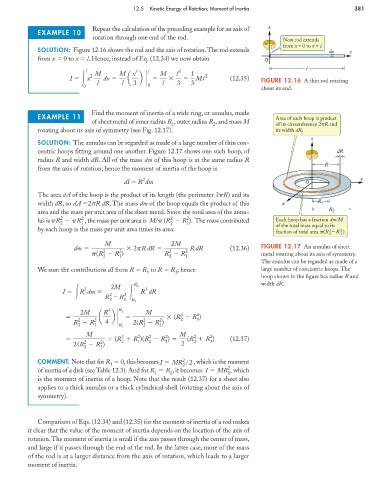
SOLUTION: Figure 12.16 shows the rod and the axis of rotation.The rod extends dx x
from x 0 to x l. Hence, instead of Eq. (12.34) we now obtain O
l
l
3
l
3
2 M M x M l 1 2
I x dx a b ` M l (12.35) FIGURE 12.16 A thin rod rotating
0 l l 3 0 l 3 3
about its end.
Find the moment of inertia of a wide ring, or annulus, made
EXAMPLE 11 Area of each hoop is product
of sheet metal of inner radius R , outer radius R , and mass M
1 2 of its circumference 2 R and
rotating about its axis of symmetry (see Fig. 12.17). its width dR.
z
SOLUTION: The annulus can be regarded as made of a large number of thin con-
centric hoops fitting around one another. Figure 12.17 shows one such hoop, of dR
radius R and width dR. All of the mass dm of this hoop is at the same radius R
R
from the axis of rotation; hence the moment of inertia of the hoop is
2 y
dI R dm O
The area dA of the hoop is the product of its length (the perimeter 2 R) and its
width dR, so dA 2 R dR. The mass dm of the hoop equals the product of this x R 1
R
area and the mass per unit area of the sheet metal. Since the total area of the annu- 2
2 2 2 2
lus is pR pR , the mass per unit area is M /p (R R ). The mass contributed Each hoop has a fraction dm/M
2 1 2 1 of the total mass equal to its
by each hoop is the mass per unit area times its area: fraction of total area (R 2 – R 1 ).
2
2
M 2M
dm 2pRdR RdR (12.36) FIGURE 12.17 An annulus of sheet
2
2
2
p(R R ) R R 2 metal rotating about its axis of symmetry.
2 1 2 1
The annulus can be regarded as made of a
We sum the contributions dI from R R to R R ; hence large number of concentric hoops. The
1 2
hoop shown in the figure has radius R and
2 2M 2 R 2 3 width dR.
I R dm 2 R dR
R R
2 1 R 1
4 R 2
2M R M 4 4
a b ` (R R )
2
1
2
2
2
R R 2 4 2(R R )
2 1 R 1 2 1
M M
2
2
2
2
2
2
(R R )(R R ) (R R ) (12.37)
1
2
1
1
2
2
2
2
2 (R R ) 2
2 1
2
COMMENT: Note that for R 0, this becomes I MR >2 , which is the moment
1 2
2
of inertia of a disk (see Table 12.3). And for R R , it becomes I MR , which
1 2 1
is the moment of inertia of a hoop. Note that the result (12.37) for a sheet also
applies to a thick annulus or a thick cylindrical shell (rotating about the axis of
symmetry).
Comparison of Eqs. (12.34) and (12.35) for the moment of inertia of a rod makes
it clear that the value of the moment of inertia depends on the location of the axis of
rotation.The moment of inertia is small if the axis passes through the center of mass,
and large if it passes through the end of the rod. In the latter case, more of the mass
of the rod is at a larger distance from the axis of rotation, which leads to a larger
moment of inertia.

