


Page 179 - Fisika Terapan for Engineers and Scientists
P. 179
12.5  Kinetic Energy of Rotation; Moment of Inertia                379


                     We can write this as

                                                  K    1 2  I  2                  (12.28)     kinetic energy of rotation


                     where the quantity

                                                       2
                                                              2
                                               2
                                        I   m R 	 m R 	 m R 	                     (12.29)     moment of inertia
                                                            3
                                                              3
                                                       2
                                                    2
                                             1
                                               1
                     is called the moment of inertia of the rotating body about the given axis.The SI unit
                                            2
                     of moment of inertia is kg m .
                        Note that Eq. (12.28) has a mathematical form reminiscent of the familiar expres-
                         1
                     sion  mv 2  for the kinetic energy of a single particle—the moment of inertia replaces
                         2
                     the mass, and the angular velocity replaces the translational velocity. As we will see in
                     the next chapter, this analogy between moment of inertia and mass is of general valid-
                     ity. The moment of inertia is a measure of the resistance that a body offers to changes in its rota-
                     tional motion, just as mass is a measure of the resistance that a body offers to changes
                     in its translational motion.
                        Equation (12.29) shows that the moment of inertia—and consequently the kinetic
                     energy for a given value of  —is large if most of the mass of the body is at a large dis-
                     tance from the axis of rotation.This is very reasonable: for a given value of  , particles
                     at large distance from the axis move with high speeds, and therefore have large kinetic
                     energies.


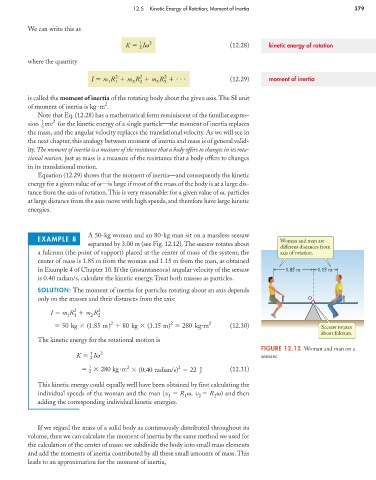
                                       A 50-kg woman and an 80-kg man sit on a massless seesaw
                        EXAMPLE 8                                                                Woman and man are
                                       separated by 3.00 m (see Fig. 12.12).The seesaw rotates about
                                                                                                 different distances from
                        a fulcrum (the point of support) placed at the center of mass of the system; the  axis of rotation.
                        center of mass is 1.85 m from the woman and 1.15 m from the man, as obtained
                        in Example 4 of Chapter 10. If the (instantaneous) angular velocity of the seesaw  1.85 m  1.15 m
                        is 0.40 radian/s, calculate the kinetic energy. Treat both masses as particles.
                        SOLUTION: The moment of inertia for particles rotating about an axis depends
                        only on the masses and their distances from the axis:                             O
                                   2      2
                              I   m R 	 m R 2
                                 1 1
                                        2
                                              2
                                                                2
                               50 kg   (1.85 m) 	 80 kg   (1.15 m)   280  kg m 2  (12.30)                     Seesaw rotates
                                                                                                              about fulcrum.
                        The kinetic energy for the rotational motion is
                                                                                            FIGURE 12.12 Woman and man on a
                                        1
                                     K   I  2                                               seesaw.
                                        2
                                       1           2              2
                                         280 kg  m   (0.40  radian/s)   22  J     (12.31)
                                       2
                        This kinetic energy could equally well have been obtained by first calculating the
                        individual speeds of the woman and the man (v   R  ,v   R  ) and then
                                                                    1
                                                                             2
                                                                         2
                                                               1
                        adding the corresponding individual kinetic energies.
                        If we regard the mass of a solid body as continuously distributed throughout its
                     volume, then we can calculate the moment of inertia by the same method we used for
                     the calculation of the center of mass: we subdivide the body into small mass elements
                     and add the moments of inertia contributed by all these small amounts of mass. This
                     leads to an approximation for the moment of inertia,

