


Page 196 - Fisika Terapan for Engineers and Scientists
P. 196
396                                CHAPTER 13  Dynamics of a Rigid Body


                                                      According to Eq. (13.3), each contribution to the work is the product of the torque
                                                     and the small angular displacement d . Thus the total work done in rotating a body
                                                   from an initial angle   to a final angle   is
                                                                     1              2
                                                                                          f 2
                                                                           W     dW       tdf                    (13.4)

                                                                                        f 1
                                                   In the special case of a constant torque, the torque may be brought outside the inte-
                                                   gral to obtain

                                                                                  f 2
                                                                         W   t    df   t(f   f )
                                                                                               1
                                                                                          2
                                                                               f 1
                                                   or simply

                      work done by constant torque                      W   t ¢f      (for     constant)         (13.5)

                                                   where            is the change in angular position during the time that the
                                                               2    1
                                                   torque is applied. Equation (13.5) is analogous to the equation for the work done
                                                   by a constant force on a body in one-dimensional translational motion, W   F  x.
                                                      From Eq. (13.2), we see that the unit of torque is the unit of force multiplied by
                                                   the unit of distance; this SI unit of torque is the newton-meter (N m).
                                                      Note that according to Eq. (13.2), for a force of given magnitude, the torque is
                                                   largest if the force acts at right angles to the radial line (    90 ) and if the force acts
                                                   at a large distance from the axis of rotation (large R). This dependence of the torque
                                                   (and of the work) on the distance from the axis of rotation and on the angle of the
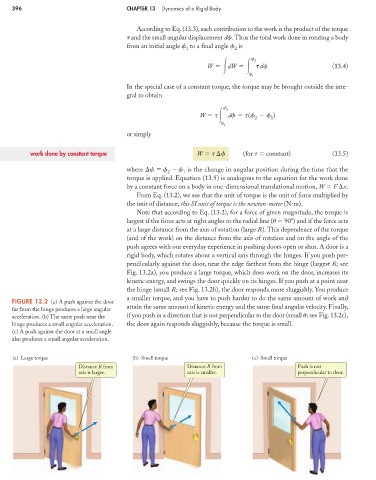
                                                   push agrees with our everyday experience in pushing doors open or shut. A door is a
                                                   rigid body, which rotates about a vertical axis through the hinges. If you push per-
                                                   pendicularly against the door, near the edge farthest from the hinge (largest R; see
                                                   Fig. 13.2a), you produce a large torque, which does work on the door, increases its
                                                   kinetic energy, and swings the door quickly on its hinges. If you push at a point near
                                                   the hinge (small R; see Fig. 13.2b), the door responds more sluggishly. You produce
                                                   a smaller torque, and you have to push harder to do the same amount of work and
                FIGURE 13.2 (a) A push against the door
                                                   attain the same amount of kinetic energy and the same final angular velocity. Finally,
                far from the hinge produces a large angular
                acceleration. (b) The same push near the  if you push in a direction that is not perpendicular to the door (small  ; see Fig. 13.2c),
                hinge produces a small angular acceleration.  the door again responds sluggishly, because the torque is small.
                (c) A push against the door at a small angle
                also produces a small angular acceleration.


                (a) Large torque                     (b) Small torque                    (c) Small torque
                                    Distance R from                  Distance R from                   Push is not
                                    axis is larger.                  axis is smaller.                  perpendicular to door.

