


Page 197 - Fisika Terapan for Engineers and Scientists
P. 197
13.1  Work, Energy, and Power in Rotational Motion; Torque                397


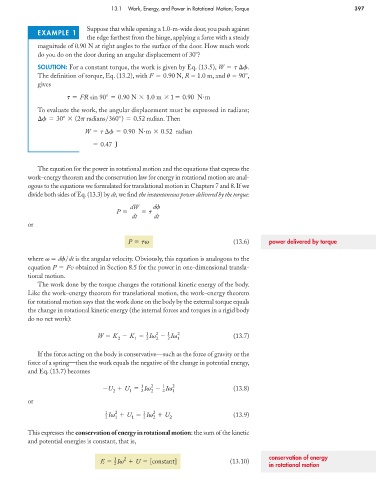
                                       Suppose that while opening a 1.0-m-wide door, you push against
                        EXAMPLE 1
                                       the edge farthest from the hinge, applying a force with a steady
                        magnitude of 0.90 N at right angles to the surface of the door. How much work
                        do you do on the door during an angular displacement of 30 ?

                        SOLUTION: For a constant torque, the work is given by Eq. (13.5), W       .
                        The definition of torque, Eq. (13.2), with F   0.90 N, R   1.0 m, and     90 ,
                        gives
                                     FR sin 90   0.90 N   1.0 m   1   0.90 N m

                        To evaluate the work, the angular displacement must be expressed in radians;
                             30   (2  radians 360 )   0.52 radian. Then

                                      W          0.90 N m   0.52 radian
                                           0.47 J


                        The equation for the power in rotational motion and the equations that express the
                     work–energy theorem and the conservation law for energy in rotational motion are anal-
                     ogous to the equations we formulated for translational motion in Chapters 7 and 8.If we
                     divide both sides of Eq.(13.3) by dt, we find the instantaneous power delivered by the torque:
                                                    dW     df
                                                P        t
                                                    dt     dt
                     or

                                                   P   t                           (13.6)     power delivered by torque

                     where     d  dt is the angular velocity. Obviously, this equation is analogous to the
                     equation P   Fv obtained in Section 8.5 for the power in one-dimensional transla-
                     tional motion.
                        The work done by the torque changes the rotational kinetic energy of the body.
                     Like the work–energy theorem for translational motion, the work–energy theorem
                     for rotational motion says that the work done on the body by the external torque equals
                     the change in rotational kinetic energy (the internal forces and torques in a rigid body
                     do no net work):

                                                            2
                                                               1
                                                         1
                                          W   K   K   I    I      2                (13.7)
                                                2    1   2  2  2  1
                        If the force acting on the body is conservative—such as the force of gravity or the
                     force of a spring—then the work equals the negative of the change in potential energy,
                     and Eq. (13.7) becomes

                                                              1
                                                          2
                                                       1
                                            U   U   I    I       2                 (13.8)
                                               2    1  2  2   2  1
                     or
                                            1  2        1  2
                                                        2
                                            2 I    U   I    U   2                  (13.9)
                                                           2
                                                    1
                                               1
                     This expresses the conservation of energy in rotational motion: the sum of the kinetic
                     and potential energies is constant, that is,
                                                  2
                                               1
                                           E   I    U   [constant]                (13.10)     conservation of energy
                                                                                              in rotational motion
                                               2

