


Page 52 - Fisika Terapan for Engineers and Scientists
P. 52
252                                CHAPTER 8  Conservation of Energy


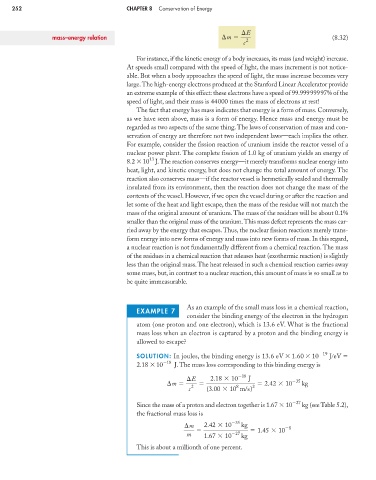
                                                                                      ¢E
                            mass–energy relation                                ¢m                               (8.32)
                                                                                       2
                                                                                      c
                                                      For instance, if the kinetic energy of a body increases, its mass (and weight) increase.
                                                   At speeds small compared with the speed of light, the mass increment is not notice-
                                                   able. But when a body approaches the speed of light, the mass increase becomes very
                                                   large.The high-energy electrons produced at the Stanford Linear Accelerator provide
                                                   an extreme example of this effect: these electrons have a speed of 99.99999997% of the
                                                   speed of light, and their mass is 44000 times the mass of electrons at rest!
                                                      The fact that energy has mass indicates that energy is a form of mass. Conversely,
                                                   as we have seen above, mass is a form of energy. Hence mass and energy must be
                                                   regarded as two aspects of the same thing.The laws of conservation of mass and con-
                                                   servation of energy are therefore not two independent laws—each implies the other.
                                                   For example, consider the fission reaction of uranium inside the reactor vessel of a
                                                   nuclear power plant. The complete fission of 1.0 kg of uranium yields an energy of
                                                          13
                                                   8.2   10 J.The reaction conserves energy—it merely transforms nuclear energy into
                                                   heat, light, and kinetic energy, but does not change the total amount of energy. The
                                                   reaction also conserves mass—if the reactor vessel is hermetically sealed and thermally
                                                   insulated from its environment, then the reaction does not change the mass of the
                                                   contents of the vessel. However, if we open the vessel during or after the reaction and
                                                   let some of the heat and light escape, then the mass of the residue will not match the
                                                   mass of the original amount of uranium.The mass of the residues will be about 0.1%
                                                   smaller than the original mass of the uranium.This mass defect represents the mass car-
                                                   ried away by the energy that escapes.Thus, the nuclear fission reactions merely trans-
                                                   form energy into new forms of energy and mass into new forms of mass. In this regard,
                                                   a nuclear reaction is not fundamentally different from a chemical reaction. The mass
                                                   of the residues in a chemical reaction that releases heat (exothermic reaction) is slightly
                                                   less than the original mass.The heat released in such a chemical reaction carries away
                                                   some mass, but, in contrast to a nuclear reaction, this amount of mass is so small as to
                                                   be quite immeasurable.


                                                                     As an example of the small mass loss in a chemical reaction,
                                                      EXAMPLE 7
                                                                     consider the binding energy of the electron in the hydrogen
                                                      atom (one proton and one electron), which is 13.6 eV. What is the fractional
                                                      mass loss when an electron is captured by a proton and the binding energy is
                                                      allowed to escape?
                                                      SOLUTION: In joules, the binding energy is 13.6 eV   1.60   10  19  J eV
                                                      2.18   10  18  J. The mass loss corresponding to this binding energy is

                                                                     ¢E     2.18   10  18   J         35
                                                               ¢m                           2.42   10   kg
                                                                      2             8     2
                                                                      c    (3.00   10 m/s)
                                                      Since the mass of a proton and electron together is 1.67   10  27  kg (see Table 5.2),
                                                      the fractional mass loss is

                                                                    ¢m    2.42   10  35  kg         8
                                                                                          1.45   10
                                                                     m    1.67   10  27  kg
                                                      This is about a millionth of one percent.

