


Page 47 - Fisika Terapan for Engineers and Scientists
P. 47
8.2  The Curve of Potential Energy                      247


                     (a)                             (b)


                         x = 9.0 m  jump-off
                                   point

                                                                       U(x)


                                   taut cord
                              0
                                   point
                                                                10 000 J
                                                                                        E
                                                                  5 000


                                                                            x             x
                                                         x 1                 0
                                                     –20     –10       0      10    20 m
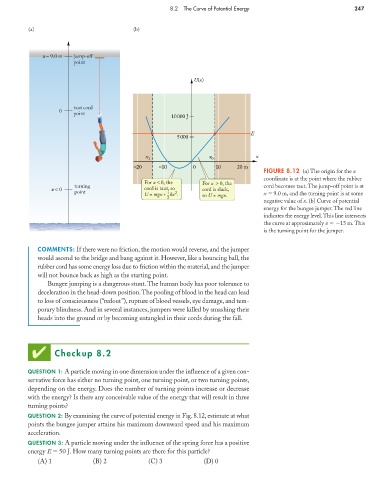
                                                                                            FIGURE 8.12 (a) The origin for the x
                                                                                            coordinate is at the point where the rubber
                                                        For x    0, the   For x     0, the
                                   turning                                                  cord becomes taut. The jump-off point is at
                            x    0                      cord is taut, so  cord is slack,
                                   point                         2
                                                                1
                                                        U = mgx +   kx  .  so U = mgx.      x   9.0 m, and the turning point is at some
                                                                2
                                                                                            negative value of x. (b) Curve of potential
                                                                                            energy for the bungee jumper. The red line
                                                                                            indicates the energy level.This line intersects
                                                                                            the curve at approximately x   15 m.This
                                                                                            is the turning point for the jumper.
                        COMMENTS: If there were no friction, the motion would reverse, and the jumper
                        would ascend to the bridge and bang against it. However, like a bouncing ball, the
                        rubber cord has some energy loss due to friction within the material, and the jumper
                        will not bounce back as high as the starting point.
                           Bungee jumping is a dangerous stunt.The human body has poor tolerance to
                        deceleration in the head-down position.The pooling of blood in the head can lead
                        to loss of consciousness (“redout”), rupture of blood vessels, eye damage, and tem-
                        porary blindness. And in several instances, jumpers were killed by smashing their
                        heads into the ground or by becoming entangled in their cords during the fall.


                      ✔      Checkup 8.2


                     QUESTION 1: A particle moving in one dimension under the influence of a given con-
                     servative force has either no turning point, one turning point, or two turning points,
                     depending on the energy. Does the number of turning points increase or decrease
                     with the energy? Is there any conceivable value of the energy that will result in three
                     turning points?
                     QUESTION 2: By examining the curve of potential energy in Fig. 8.12, estimate at what
                     points the bungee jumper attains his maximum downward speed and his maximum
                     acceleration.
                     QUESTION 3: A particle moving under the influence of the spring force has a positive
                     energy E   50 J. How many turning points are there for this particle?
                        (A) 1            (B) 2           (C) 3            (D) 0

