


Page 54 - Fisika Terapan for Engineers and Scientists
P. 54
254                                CHAPTER 8  Conservation of Energy


                                                   by the maximum force exerted by the engine on the wheels, and this is not directly
                                                   related to the power as defined above.
                                                      The SI unit of power is the watt (W), which is the rate of work of one joule per
                                                   second:

                                                                            1 watt   1 W   1  J s
                                                   In engineering practice, power is often measured in  horsepower (hp) units, where

                                                                        1 horsepower   1 hp   746 W              (8.35)
                                                   This is roughly the rate at which a (very strong) horse can do work.
                                                      Note that multiplication of a unit of power by a unit of time gives a unit of energy.
                                                   An example of this is the kilowatt-hour (kW
h), already mentioned in Section 8.3:

                                                           1 kilowatt-hour   1 kW
h   1 kW   1 h   1000 W   3600s
                                                                                                                 (8.36)
                                                                                 6
                                                                          3.6   10 J
                JAMES WATT (1736–1819) Scottish    This unit is commonly used to measure the electric energy delivered to homes and
                inventor and engineer. He modified and  factories.
                improved an earlier steam engine and founded  For a constant (or average) power P delivered to a body during a time
t, the work
                the first factory constructing steam engines.

W delivered is the rate times the time [see Eq. (8.33)]:
                Watt introduced the horsepower as a unit of
                mechanical power.
                                                                                W   P
t                         (8.37)
                                                   If the rate of doing work P varies with time, then the total work W done between a
                                                   time t and another time t is the sum of the infinitesimal P
t contributions; that is,
                                                        1               2
                                                   the work done is the integral of the power over time:
                                                                                         t 2
                                                                            W   dW       P dt                    (8.38)

                                                                                        t 1

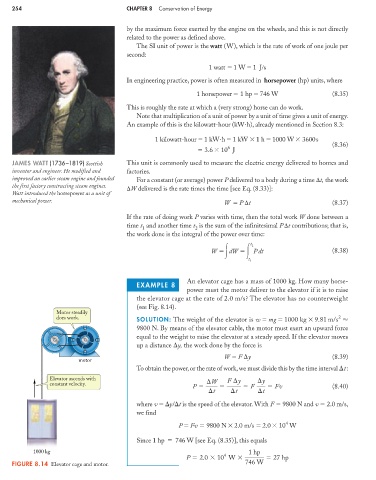
                                                                     An elevator cage has a mass of 1000 kg. How many horse-
                                                      EXAMPLE 8
                                                                     power must the motor deliver to the elevator if it is to raise
                                                      the elevator cage at the rate of 2.0 m/s? The elevator has no counterweight
                                                      (see Fig. 8.14).
                             Motor steadily
                                                                                                                   2
                             does work.               SOLUTION: The weight of the elevator is w   mg   1000 kg   9.81 m/s
                                                      9800 N. By means of the elevator cable, the motor must exert an upward force
                                                      equal to the weight to raise the elevator at a steady speed. If the elevator moves
                                                      up a distance
y, the work done by the force is

                                                                                W   F
y                         (8.39)
                                    motor
                                                      To obtain the power,or the rate of work,we must divide this by the time interval
t:
                           Elevator ascends with                                 F ¢y     ¢y
                           constant velocity.                          P    ¢W                 Fv                (8.40)
                                                                            ¢t    ¢t    F    ¢t

                                                      where v
y/
t is the speed of the elevator. With F   9800 N and v   2.0 m/s,
                                                      we find
                                                                                                   4
                                                                   P   Fv   9800 N   2.0 m/s   2.0   10 W
                                                      Since 1 hp    746 W [see Eq. (8.35)], this equals

                      1000 kg                                                           1 hp
                                                                                4
                                                                     P   2.0   10 W            27 hp
                FIGURE 8.14 Elevator cage and motor.                                   746 W

