


Page 50 - Fisika Terapan for Engineers and Scientists
P. 50
250                                CHAPTER 8  Conservation of Energy


                                                      Expressed in kW
h , this amounts to
                                                                                    .
                                                                                1 kW h
                                                                        13                        7
                                                                 6.0   10  J              1.7   10 kW
h
                                                                              3.6   10 J
                                                                                      6
                                                      (The actual electric energy that can be generated is about 30% less than that,
                                                      because of frictional losses during the conversion from one form of energy to the
                                                      other. These frictional losses result in the generation of heat.)


                                                                     The “calorie” used by dietitians to express the energy equivalents
                                                      EXAMPLE 6
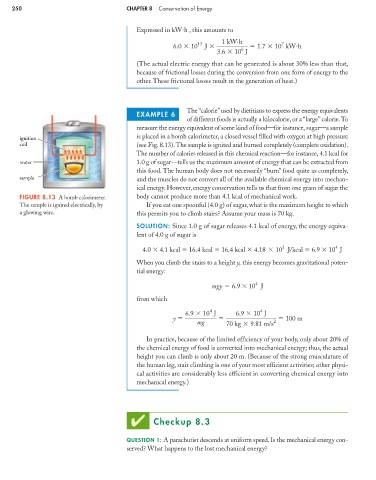
                                                                     of different foods is actually a kilocalorie, or a “large” calorie.To
                                                      measure the energy equivalent of some kind of food—for instance, sugar—a sample
                                                      is placed in a bomb calorimeter, a closed vessel filled with oxygen at high pressure
                  ignition
                  coil                                (see Fig. 8.13).The sample is ignited and burned completely (complete oxidation).
                                                      The number of calories released in this chemical reaction—for instance, 4.1 kcal for
                  water                               1.0 g of sugar—tells us the maximum amount of energy that can be extracted from
                                                      this food. The human body does not necessarily “burn” food quite as completely,
                  sample                              and the muscles do not convert all of the available chemical energy into mechan-
                                                      ical energy. However, energy conservation tells us that from one gram of sugar the
                  FIGURE 8.13 A bomb calorimeter.     body cannot produce more than 4.1 kcal of mechanical work.
                  The sample is ignited electrically, by  If you eat one spoonful (4.0 g) of sugar, what is the maximum height to which
                  a glowing wire.                     this permits you to climb stairs? Assume your mass is 70 kg.

                                                      SOLUTION: Since 1.0 g of sugar releases 4.1 kcal of energy, the energy equiva-
                                                      lent of 4.0 g of sugar is

                                                                                                  3               4
                                                        4.0   4.1 kcal   16.4 kcal   16.4 kcal   4.18   10 J/kcal   6.9   10 J
                                                      When you climb the stairs to a height y, this energy becomes gravitational poten-
                                                      tial energy:

                                                                                          4
                                                                             mgy   6.9   10 J
                                                      from which
                                                                            4
                                                                                           4
                                                                     6.9   10  J    6.9   10 J
                                                                 y                                 100 m
                                                                        mg       70 kg   9.81 m/s 2
                                                         In practice, because of the limited efficiency of your body, only about 20% of
                                                      the chemical energy of food is converted into mechanical energy; thus, the actual
                                                      height you can climb is only about 20 m. (Because of the strong musculature of
                                                      the human leg, stair climbing is one of your most efficient activities; other physi-
                                                      cal activities are considerably less efficient in converting chemical energy into
                                                      mechanical energy.)


                                                    ✔      Checkup 8.3


                                                   QUESTION 1: A parachutist descends at uniform speed. Is the mechanical energy con-
                                                   served? What happens to the lost mechanical energy?

