


Page 58 - Fisika Terapan for Engineers and Scientists
P. 58
258                                CHAPTER 8  Conservation of Energy


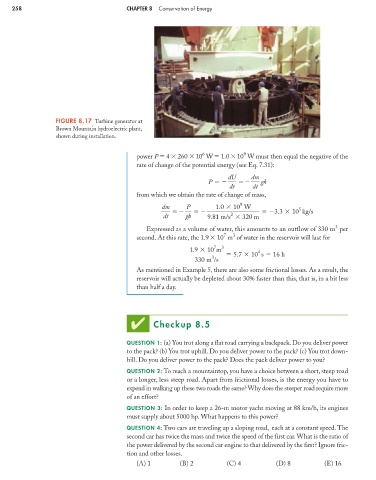
                             FIGURE 8.17 Turbine generator at
                             Brown Mountain hydroelectric plant,
                             shown during installation.

                                                                                      9
                                                                          6
                                                      power P   4   260   10 W   1.0   10 W must then equal the negative of the
                                                      rate of change of the potential energy (see Eq. 7.31):
                                                                                  dU     dm
                                                                            P                gh
                                                                                  dt     dt
                                                      from which we obtain the rate of change of mass,
                                                                                     9
                                                             dm      P        1.0   10 W               5
                                                                                              3.3   10 kg/s
                                                                                  2
                                                              dt     gh    9.81 m/s   320 m
                                                                                                                  3
                                                         Expressed as a volume of water, this amounts to an outflow of 330 m per
                                                                                7
                                                                                   3
                                                      second. At this rate, the 1.9   10 m of water in the reservoir will last for
                                                                             7
                                                                      1.9   10 m 3
                                                                                           4
                                                                                   5.7   10 s   16 h
                                                                             3
                                                                       330 m /s
                                                      As mentioned in Example 5, there are also some frictional losses. As a result, the
                                                      reservoir will actually be depleted about 30% faster than this, that is, in a bit less
                                                      than half a day.

                                                    ✔      Checkup 8.5


                                                   QUESTION 1: (a) You trot along a flat road carrying a backpack. Do you deliver power
                                                   to the pack? (b) You trot uphill. Do you deliver power to the pack? (c) You trot down-
                                                   hill. Do you deliver power to the pack? Does the pack deliver power to you?
                                                   QUESTION 2: To reach a mountaintop, you have a choice between a short, steep road
                                                   or a longer, less steep road. Apart from frictional losses, is the energy you have to
                                                   expend in walking up these two roads the same? Why does the steeper road require more
                                                   of an effort?
                                                   QUESTION 3: In order to keep a 26-m motor yacht moving at 88 km/h, its engines
                                                   must supply about 5000 hp. What happens to this power?
                                                   QUESTION 4: Two cars are traveling up a sloping road, each at a constant speed.The
                                                   second car has twice the mass and twice the speed of the first car. What is the ratio of
                                                   the power delivered by the second car engine to that delivered by the first? Ignore fric-
                                                   tion and other losses.
                                                      (A) 1        (B) 2         (C) 4          (D) 8          (E) 16

