


Page 6 - Fisika Terapan for Engineers and Scientists
P. 6
206                                CHAPTER 7  Work and Energy


                                                                                               Force parallel to
                              This force F has only                             (a)            the motion does
                              an x component, F .                                              positive work.
                                          x
                                                                                 positive work
                                                                                                   motion
                                       F F                                                  F F


                                            x                                                    x
                                                                                (b)
                              For work to be done
                              by a force, there must
                              be a displacement.                                                motion   negative work
                                                                                                F F
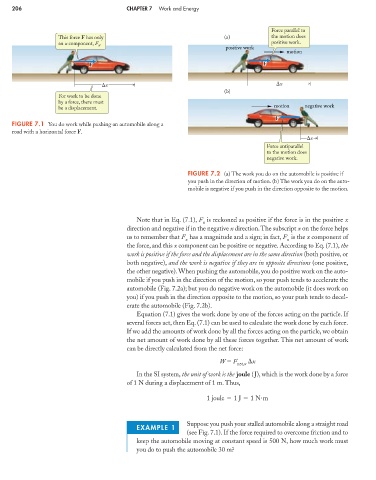
                FIGURE 7.1 You do work while pushing an automobile along a
                road with a horizontal force F.
                                                                                                           x
                                                                                             Force antiparallel
                                                                                             to the motion does
                                                                                             negative work.

                                                                     FIGURE 7.2 (a) The work you do on the automobile is positive if
                                                                     you push in the direction of motion. (b) The work you do on the auto-
                                                                     mobile is negative if you push in the direction opposite to the motion.


                                                      Note that in Eq. (7.1), F is reckoned as positive if the force is in the positive x
                                                                          x
                                                   direction and negative if in the negative x direction.The subscript x on the force helps
                                                   us to remember that F has a magnitude and a sign; in fact, F is the x component of
                                                                     x
                                                                                                   x
                                                   the force, and this x component can be positive or negative. According to Eq. (7.1), the
                                                   work is positive if the force and the displacement are in the same direction (both positive, or
                                                   both negative), and the work is negative if they are in opposite directions (one positive,
                                                   the other negative). When pushing the automobile, you do positive work on the auto-
                                                   mobile if you push in the direction of the motion, so your push tends to accelerate the
                                                   automobile (Fig. 7.2a); but you do negative work on the automobile (it does work on
                                                   you) if you push in the direction opposite to the motion, so your push tends to decel-
                                                   erate the automobile (Fig. 7.2b).
                                                      Equation (7.1) gives the work done by one of the forces acting on the particle. If
                                                   several forces act, then Eq. (7.1) can be used to calculate the work done by each force.
                                                   If we add the amounts of work done by all the forces acting on the particle, we obtain
                                                   the net amount of work done by all these forces together. This net amount of work
                                                   can be directly calculated from the net force:
                                                                               W   F     x
                                                                                    net,x
                                                      In the SI system, the unit of work is the joule (J), which is the work done by a force
                                                   of 1 N during a displacement of 1 m. Thus,
                                                                           1 joule   1 J   1 N m


                                                                     Suppose you push your stalled automobile along a straight road
                                                      EXAMPLE 1
                                                                     (see Fig. 7.1). If the force required to overcome friction and to
                                                      keep the automobile moving at constant speed is 500 N, how much work must
                                                      you do to push the automobile 30 m?

