


Page 11 - Fisika Terapan for Engineers and Scientists
P. 11
7.2  Work for a Variable Force                        211


                     QUESTION 4: You are trying to stop a moving cart by pushing against its front end. Do  (a)  (b)
                     you do positive or negative work on the cart? What if you pull on the rear end?
                     QUESTION 5: You are whirling a stone tied to a string around a circle. Does the ten-  F        F
                     sion of the string do any work on the stone?
                                                                                                                    s
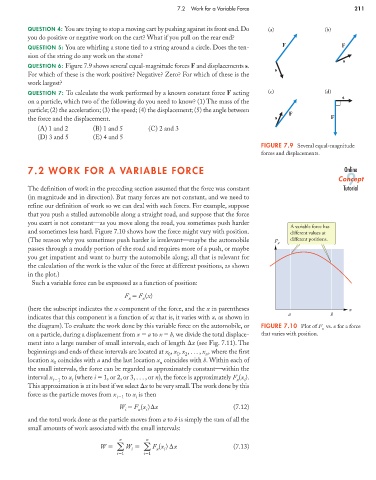
                     QUESTION 6: Figure 7.9 shows several equal-magnitude forces F and displacements s.
                                                                                                s
                     For which of these is the work positive? Negative? Zero? For which of these is the
                     work largest?
                     QUESTION 7: To calculate the work performed by a known constant force F acting  (c)       (d)
                                                                                                                    s
                     on a particle, which two of the following do you need to know? (1) The mass of the
                     particle; (2) the acceleration; (3) the speed; (4) the displacement; (5) the angle between
                                                                                                    F
                     the force and the displacement.                                            s                F
                        (A) 1 and 2      (B) 1 and 5     (C) 2 and 3
                        (D) 3 and 5      (E) 4 and 5
                                                                                            FIGURE 7.9 Several equal-magnitude
                                                                                            forces and displacements.

                     7.2 WORK FOR A VARIABLE FORCE                                                                   Online
                                                                                                                      9
                                                                                                                   Concept
                     The definition of work in the preceding section assumed that the force was constant             Tutorial
                     (in magnitude and in direction). But many forces are not constant, and we need to
                     refine our definition of work so we can deal with such forces. For example, suppose
                     that you push a stalled automobile along a straight road, and suppose that the force
                     you exert is not constant—as you move along the road, you sometimes push harder
                                                                                                    A variable force has
                     and sometimes less hard. Figure 7.10 shows how the force might vary with position.  different values at
                     (The reason why you sometimes push harder is irrelevant—maybe the automobile  F x  different positions.
                     passes through a muddy portion of the road and requires more of a push, or maybe
                     you get impatient and want to hurry the automobile along; all that is relevant for
                     the calculation of the work is the value of the force at different positions, as shown
                     in the plot.)
                      Such a variable force can be expressed as a function of position:

                                                  F   F (x)
                                                   x    x
                     (here the subscript indicates the x component of the force, and the x in parentheses             x
                                                                                                    a            b
                     indicates that this component is a function of x; that is, it varies with x, as shown in
                     the diagram). To evaluate the work done by this variable force on the automobile, or  FIGURE 7.10 Plot of F vs. x for a force
                                                                                                              x
                     on a particle, during a displacement from x   a to x   b, we divide the total displace-  that varies with position.
                     ment into a large number of small intervals, each of length  x (see Fig. 7.11). The
                     beginnings and ends of these intervals are located at x , x , x ,..., x , where the first
                                                               0  1  2     n
                     location x coincides with a and the last location x coincides with b. Within each of
                             0                               n
                     the small intervals, the force can be regarded as approximately constant—within the
                     interval x  to x (where i   1,or 2,or 3,...,or n), the force is approximately F (x ).
                            i 1   i                                                 x  i
                     This approximation is at its best if we select  x to be very small.The work done by this
                     force as the particle moves from x  to x is then
                                                i 1   i
                                                 W   F (x ) x                      (7.12)
                                                  i   x  i
                     and the total work done as the particle moves from a to b is simply the sum of all the
                     small amounts of work associated with the small intervals:
                                                 n       n
                                           W    a  W    a  F (x ) ¢x               (7.13)
                                                    i
                                                            x
                                                i 1     i 1   i

