


Page 8 - Fisika Terapan for Engineers and Scientists
P. 8
208                                CHAPTER 7  Work and Energy


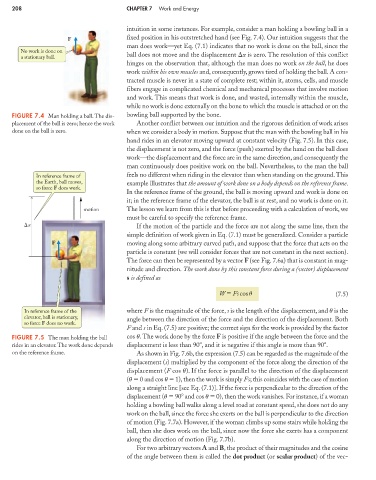
                                                   intuition in some instances. For example, consider a man holding a bowling ball in a
                                 F                 fixed position in his outstretched hand (see Fig. 7.4). Our intuition suggests that the
                                                   man does work—yet Eq. (7.1) indicates that no work is done on the ball, since the
                   No work is done on
                   a stationary ball.              ball does not move and the displacement  x is zero. The resolution of this conflict
                                                   hinges on the observation that, although the man does no work on the ball, he does
                                                   work within his own muscles and, consequently, grows tired of holding the ball. A con-
                                                   tracted muscle is never in a state of complete rest; within it, atoms, cells, and muscle
                                                   fibers engage in complicated chemical and mechanical processes that involve motion
                                                   and work. This means that work is done, and wasted, internally within the muscle,
                                                   while no work is done externally on the bone to which the muscle is attached or on the
                FIGURE 7.4 Man holding a ball. The dis-  bowling ball supported by the bone.
                placement of the ball is zero; hence the work  Another conflict between our intuition and the rigorous definition of work arises
                done on the ball is zero.          when we consider a body in motion. Suppose that the man with the bowling ball in his
                                                   hand rides in an elevator moving upward at constant velocity (Fig. 7.5). In this case,
                                                   the displacement is not zero, and the force (push) exerted by the hand on the ball does
                                                   work—the displacement and the force are in the same direction, and consequently the
                                                   man continuously does positive work on the ball. Nevertheless, to the man the ball
                       In reference frame of       feels no different when riding in the elevator than when standing on the ground.This
                       the Earth, ball moves,      example illustrates that the amount of work done on a body depends on the reference frame.
                       so force F does work.
                                                   In the reference frame of the ground, the ball is moving upward and work is done on
                                                   it; in the reference frame of the elevator, the ball is at rest, and no work is done on it.
                                      motion       The lesson we learn from this is that before proceeding with a calculation of work, we
                                                   must be careful to specify the reference frame.
                     x                                If the motion of the particle and the force are not along the same line, then the
                                                   simple definition of work given in Eq. (7.1) must be generalized. Consider a particle
                            F                      moving along some arbitrary curved path, and suppose that the force that acts on the
                                                   particle is constant (we will consider forces that are not constant in the next section).
                                                   The force can then be represented by a vector F (see Fig. 7.6a) that is constant in mag-
                                                   nitude and direction. The work done by this constant force during a (vector) displacement
                                                   s is defined as
                                                                               W   Fs cos                         (7.5)


                    In reference frame of the      where F is the magnitude of the force, s is the length of the displacement, and   is the
                    elevator, ball is stationary,  angle between the direction of the force and the direction of the displacement. Both
                    so force F does no work.
                                                   F and s in Eq. (7.5) are positive; the correct sign for the work is provided by the factor
                FIGURE 7.5 The man holding the ball  cos  .The work done by the force F is positive if the angle between the force and the
                rides in an elevator. The work done depends  displacement is less than 90 , and it is negative if this angle is more than 90 .
                on the reference frame.               As shown in Fig. 7.6b, the expression (7.5) can be regarded as the magnitude of the
                                                   displacement (s) multiplied by the component of the force along the direction of the
                                                   displacement (F cos  ). If the force is parallel to the direction of the displacement
                                                   (   0 and cos   1), then the work is simply Fs; this coincides with the case of motion
                                                   along a straight line [see Eq. (7.1)]. If the force is perpendicular to the direction of the
                                                   displacement (    90  and cos     0), then the work vanishes. For instance, if a woman
                                                   holding a bowling ball walks along a level road at constant speed, she does not do any
                                                   work on the ball, since the force she exerts on the ball is perpendicular to the direction
                                                   of motion (Fig. 7.7a). However, if the woman climbs up some stairs while holding the
                                                   ball, then she does work on the ball, since now the force she exerts has a component
                                                   along the direction of motion (Fig. 7.7b).
                                                      For two arbitrary vectors A and B, the product of their magnitudes and the cosine
                                                   of the angle between them is called the dot product (or scalar product) of the vec-

