


Page 9 - Fisika Terapan for Engineers and Scientists
P. 9
7.1  Work                               209


                       (a)
                             F
                                          s
                            q
                                                                   (a)          Zero work is done  (b)     Positive work is
                                                                                when q = 90°.              done for q    90°.
                       (b)
                                                                                                              F
                             F
                                                                                                               q
                                                                                   F                              s
                                          s                                          90°
                            q
                            F cos q                                                     s

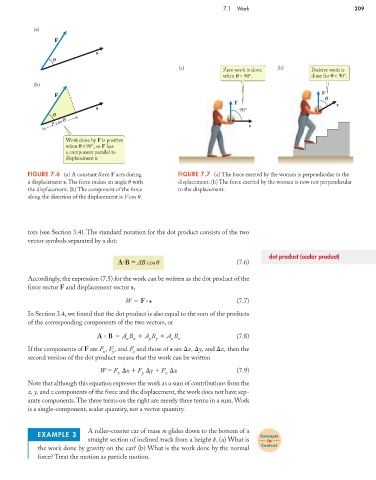
                                Work done by F is positive
                                when q   90°, so F has
                                a component parallel to
                                displacement s.

                     FIGURE 7.6 (a) A constant force F acts during  FIGURE 7.7 (a) The force exerted by the woman is perpendicular to the
                     a displacement s. The force makes an angle   with  displacement. (b) The force exerted by the woman is now not perpendicular
                     the displacement. (b) The component of the force  to the displacement.
                     along the direction of the displacement is F cos  .


                     tors (see Section 3.4). The standard notation for the dot product consists of the two
                     vector symbols separated by a dot:


                                                                                              dot product (scalar product)
                                                A B   AB cos                        (7.6)

                     Accordingly, the expression (7.5) for the work can be written as the dot product of the
                     force vector F and displacement vector s,

                                                  W   F # s                         (7.7)
                     In Section 3.4, we found that the dot product is also equal to the sum of the products
                     of the corresponding components of the two vectors, or

                                          A   B   A B   A B   A B                   (7.8)
                                                   x  x   y  y  z  z
                     If the components of F are F ,F , and F and those of s are  x,  y, and  z, then the
                                            x  y     z
                     second version of the dot product means that the work can be written
                                           W   F  x   F  y   F  z                   (7.9)
                                                x      y      z
                     Note that although this equation expresses the work as a sum of contributions from the
                     x, y, and z components of the force and the displacement, the work does not have sep-
                     arate components.The three terms on the right are merely three terms in a sum. Work
                     is a single-component, scalar quantity, not a vector quantity.


                                       A roller-coaster car of mass m glides down to the bottom of a
                        EXAMPLE 3                                                          Concepts
                                       straight section of inclined track from a height h. (a) What is  in
                                                                                            Context
                        the work done by gravity on the car? (b) What is the work done by the normal
                        force? Treat the motion as particle motion.

