


Page 67 - Fisika Terapan for Engineers and Scientists
P. 67
Problems                              267


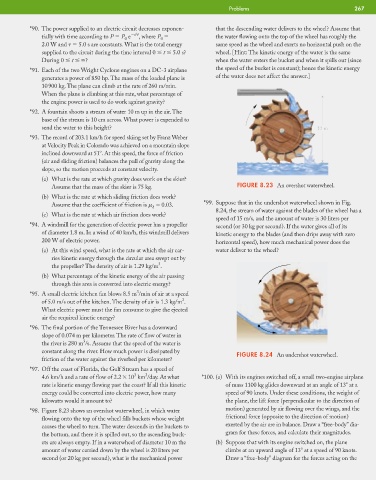
                     *90. The power supplied to an electric circuit decreases exponen-  that the descending water delivers to the wheel? Assume that
                         tially with time according to P   P e  t/  , where P    the water flowing onto the top of the wheel has roughly the
                                                  0
                                                             0
                         2.0 W and     5.0 s are constants. What is the total energy  same speed as the wheel and exerts no horizontal push on the
                         supplied to the circuit during the time interval 0   t   5.0 s?  wheel. [Hint: The kinetic energy of the water is the same
                         During 0   t    ?                                    when the water enters the bucket and when it spills out (since
                     *91. Each of the two Wright Cyclone engines on a DC-3 airplane  the speed of the bucket is constant); hence the kinetic energy
                         generates a power of 850 hp. The mass of the loaded plane is  of the water does not affect the answer.]
                         10900 kg. The plane can climb at the rate of 260 m/min.
                         When the plane is climbing at this rate, what percentage of
                         the engine power is used to do work against gravity?
                     *92. A fountain shoots a stream of water 10 m up in the air. The
                         base of the stream is 10 cm across. What power is expended to
                         send the water to this height?
                     *93. The record of 203.1 km/h for speed skiing set by Franz Weber
                         at Velocity Peak in Colorado was achieved on a mountain slope
                         inclined downward at 51 . At this speed, the force of friction
                         (air and sliding friction) balances the pull of gravity along the
                         slope, so the motion proceeds at constant velocity.
                         (a) What is the rate at which gravity does work on the skier?
                            Assume that the mass of the skier is 75 kg.             FIGURE 8.23 An overshot waterwheel.
                         (b) What is the rate at which sliding friction does work?
                            Assume that the coefficient of friction is     0.03.  *99. Suppose that in the undershot waterwheel shown in Fig.
                                                           k
                                                                              8.24, the stream of water against the blades of the wheel has a
                         (c) What is the rate at which air friction does work?
                                                                              speed of 15 m/s, and the amount of water is 30 liters per
                     *94. A windmill for the generation of electric power has a propeller  second (or 30 kg per second). If the water gives all of its
                         of diameter 1.8 m. In a wind of 40 km/h, this windmill delivers  kinetic energy to the blades (and then drips away with zero
                         200 W of electric power.                             horizontal speed), how much mechanical power does the
                         (a) At this wind speed, what is the rate at which the air car-  water deliver to the wheel?
                            ries kinetic energy through the circular area swept out by
                                                            3
                            the propeller? The density of air is 1.29 kg/m .
                         (b) What percentage of the kinetic energy of the air passing
                            through this area is converted into electric energy?
                                                      3
                     *95. A small electric kitchen fan blows 8.5 m /min of air at a speed
                                                                    3
                         of 5.0 m/s out of the kitchen. The density of air is 1.3 kg/m .
                         What electric power must the fan consume to give the ejected
                         air the required kinetic energy?
                     *96. The final portion of the Tennessee River has a downward
                         slope of 0.074 m per kilometer. The rate of flow of water in
                                      3
                         the river is 280 m /s. Assume that the speed of the water is
                         constant along the river. How much power is dissipated by
                                                                                    FIGURE 8.24 An undershot waterwheel.
                         friction of the water against the riverbed per kilometer?
                     *97. Off the coast of Florida, the Gulf Stream has a speed of
                                                     3
                                                        3
                         4.6 km/h and a rate of flow of 2.2   10 km /day. At what   *100. (a) With its engines switched off, a small two-engine airplane
                         rate is kinetic energy flowing past the coast? If all this kinetic  of mass 1100 kg glides downward at an angle of 13  at a
                         energy could be converted into electric power, how many  speed of 90 knots. Under these conditions, the weight of
                         kilowatts would it amount to?                           the plane, the lift force (perpendicular to the direction of
                     *98. Figure 8.23 shows an overshot waterwheel, in which water  motion) generated by air flowing over the wings, and the
                         flowing onto the top of the wheel fills buckets whose weight  frictional force (opposite to the direction of motion)
                         causes the wheel to turn. The water descends in the buckets to  exerted by the air are in balance. Draw a “free-body” dia-
                         the bottom, and there it is spilled out, so the ascending buck-  gram for these forces, and calculate their magnitudes.
                         ets are always empty. If in a waterwheel of diameter 10 m the  (b) Suppose that with its engine switched on, the plane
                         amount of water carried down by the wheel is 20 liters per  climbs at an upward angle of 13  at a speed of 90 knots.
                         second (or 20 kg per second), what is the mechanical power  Draw a “free-body” diagram for the forces acting on the

