


Page 68 - Fisika Terapan for Engineers and Scientists
P. 68
268                                CHAPTER 8  Conservation of Energy


                       airplane under these conditions; include the push that the  (The reaction involves several intermediate steps, but this need
                       air exerts on the propeller. Calculate the magnitudes of all  not concern us now.) The mass of the hydrogen (H) atom is
                       the forces.                                       1.00813 u, and that of the helium (He) atom is 4.00388 u.
                    (c) Calculate the power that the engine must deliver to com-  (a) How much energy is released in the reaction of four
                       pensate for the rate of increase of the potential energy of  hydrogen atoms (by the conversion of mass into
                       the plane and the power lost to friction. For a typical small  energy)?
                       plane of 1100 kg, the actual engine power required for  (b) How much energy is released in the reaction of 1.0 kg of
                       such a climb of 13  is about 400 hp. Explain the discrep-  hydrogen atoms?
                       ancy between your result and the actual engine power.                                 26
                                                                         (c) The Sun releases energy at the rate of 3.9   10 W. At
                       (Hint: What does the propeller do to the air?)
                                                                            what rate (in kg/s) does the Sun consume hydrogen?
                *101. The reaction that supplies the Sun with energy is                             30
                                                                         (d) The Sun contains about 1.5   10 kg of hydrogen. If it
                             H   H   H   H S He   [energy]                  continues to consume hydrogen at the same rate, how
                                                                            long will the hydrogen last?


                REVIEW PROBLEMS


                102. A particle moves along the x axis under the influence of a vari-  path II consisting of a horizontal and a vertical segment (see
                                 2
                    able force F   5x   3x (where force is measured in newtons  Fig. 8.25). Is the force conservative?
                             x
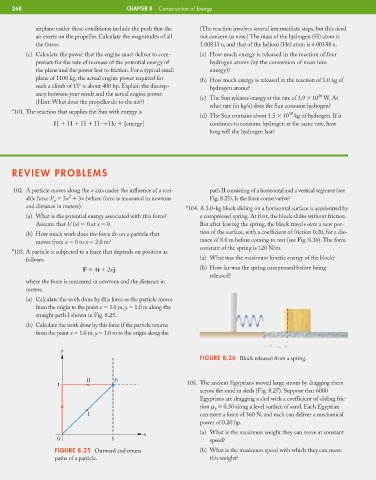
                    and distance in meters).                         *104. A 3.0-kg block sliding on a horizontal surface is accelerated by
                    (a) What is the potential energy associated with this force?  a compressed spring. At first, the block slides without friction.
                       Assume that U (x)   0 at x   0.                   But after leaving the spring, the block travels over a new por-
                    (b) How much work does the force do on a particle that  tion of the surface, with a coefficient of friction 0.20, for a dis-
                       moves from x   0 to x   2.0 m?                    tance of 8.0 m before coming to rest (see Fig. 8.26). The force
                                                                         constant of the spring is 120 N/m.
                *103. A particle is subjected to a force that depends on position as
                    follows:                                             (a) What was the maximum kinetic energy of the block?
                                      F   4i   2xj                       (b) How far was the spring compressed before being
                                                                            released?
                    where the force is measured in newtons and the distance in
                    meters.
                    (a) Calculate the work done by this force as the particle moves
                       from the origin to the point x  1.0 m, y  1.0 m along the
                       straight path I shown in Fig. 8.25.
                    (b) Calculate the work done by this force if the particle returns
                       from the point x 1.0 m, y 1.0 m to the origin along the

                               y
                                                                         FIGURE 8.26 Block released from a spring.


                                       II      P
                              1                                      105. The ancient Egyptians moved large stones by dragging them
                                                                         across the sand in sleds (Fig. 8.27). Suppose that 6000
                                                                         Egyptians are dragging a sled with a coefficient of sliding fric-
                                                                         tion     0.30 along a level surface of sand. Each Egyptian
                                                                              k
                                       I                                 can exert a force of 360 N, and each can deliver a mechanical
                                                                         power of 0.20 hp.
                                                        x                (a) What is the maximum weight they can move at constant
                              O               1                             speed?
                             FIGURE 8.25 Outward and return              (b) What is the maximum speed with which they can move
                             paths of a particle.                           this weight?

