


Page 64 - Fisika Terapan for Engineers and Scientists
P. 64
264                                CHAPTER 8  Conservation of Energy


                                                                      45. How much energy is released by the annihilation of one
                                                                         proton and one antiproton (both initially at rest)? Express
                                                                         your answer in electron-volts.
                                                                      46. How much energy is released by the annihilation of one elec-
                                                                         tron and one antielectron (both initially at rest)? Express your
                                                                         answer in electron-volts.
                                                                                               30
                                                                      47. The mass of the Sun is 2   10 kg. The thermal energy in the
                                                                                       41
                                                                         Sun is about 2   10 J. How much does the thermal energy
                                                                         contribute to the mass of the Sun?
                                                                      48. The masses of the proton, electron, and neutron are 1.672623
                                                                         10   27  kg, 9.11   10  31  kg, and 1.674929   10  27  kg, respec-
                                                                         tively. If a neutron decays into a proton and an electron, how
                                                                         much energy is released (other than the energy of the mass of
                                                                         the proton and electron)? Compare this extra energy with the
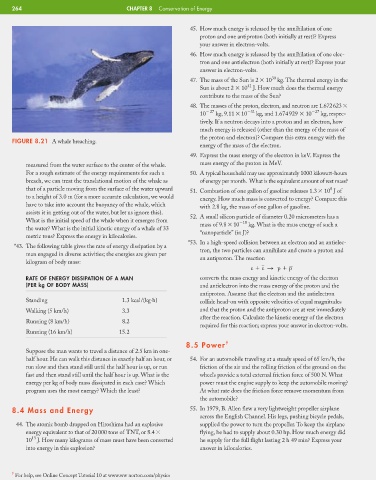
                FIGURE 8.21 A whale breaching.
                                                                         energy of the mass of the electron.
                                                                      49. Express the mass energy of the electron in keV. Express the
                    measured from the water surface to the center of the whale.  mass energy of the proton in MeV.
                    For a rough estimate of the energy requirements for such a  50. A typical household may use approximately 1000 kilowatt-hours
                    breach, we can treat the translational motion of the whale as  of energy per month. What is the equivalent amount of rest mass?
                    that of a particle moving from the surface of the water upward                               8
                                                                      51. Combustion of one gallon of gasoline releases 1.3   10 J of
                    to a height of 3.0 m (for a more accurate calculation, we would
                                                                         energy. How much mass is converted to energy? Compare this
                    have to take into account the buoyancy of the whale, which
                                                                         with 2.8 kg, the mass of one gallon of gasoline.
                    assists it in getting out of the water, but let us ignore this).
                                                                      52. A small silicon particle of diameter 0.20 micrometers has a
                    What is the initial speed of the whale when it emerges from       18
                                                                         mass of 9.8   10  kg. What is the mass energy of such a
                    the water? What is the initial kinetic energy of a whale of 33
                                                                         “nanoparticle” (in J)?
                    metric tons? Express the energy in kilocalories.
                                                                     *53. In a high-speed collision between an electron and an antielec-
                 *43. The following table gives the rate of energy dissipation by a
                                                                         tron, the two particles can annihilate and create a proton and
                    man engaged in diverse activities; the energies are given per
                                                                         an antiproton. The reaction
                    kilogram of body mass:

                                                                                        e   e  S   p   p
                    RATE OF ENERGY DISSIPATION OF A MAN                  converts the mass energy and kinetic energy of the electron
                    (PER kg OF BODY MASS)                                and antielectron into the mass energy of the proton and the
                                                                         antiproton. Assume that the electron and the antielectron
                    Standing                     1.3 kcal/(kg . h)       collide head-on with opposite velocities of equal magnitudes
                    Walking (5 km/h)             3.3                     and that the proton and the antiproton are at rest immediately
                                                                         after the reaction. Calculate the kinetic energy of the electron
                    Running (8 km/h)             8.2
                                                                         required for this reaction; express your answer in electron-volts.
                    Running (16 km/h)            15.2
                                                                     8.5 Power   †
                    Suppose the man wants to travel a distance of 2.5 km in one-
                    half hour. He can walk this distance in exactly half an hour, or  54. For an automobile traveling at a steady speed of 65 km/h, the
                    run slow and then stand still until the half hour is up, or run  friction of the air and the rolling friction of the ground on the
                    fast and then stand still until the half hour is up. What is the  wheels provide a total external friction force of 500 N. What
                    energy per kg of body mass dissipated in each case? Which  power must the engine supply to keep the automobile moving?
                    program uses the most energy? Which the least?       At what rate does the friction force remove momentum from
                                                                         the automobile?
                8.4 Mass and Energy                                   55. In 1979, B. Allen flew a very lightweight propeller airplane
                                                                         across the English Channel. His legs, pushing bicycle pedals,
                 44. The atomic bomb dropped on Hiroshima had an explosive  supplied the power to turn the propeller. To keep the airplane
                    energy equivalent to that of 20000 tons of TNT, or 8.4    flying, he had to supply about 0.30 hp. How much energy did
                      13
                    10 J. How many kilograms of mass must have been converted  he supply for the full flight lasting 2 h 49 min? Express your
                    into energy in this explosion?                       answer in kilocalories.


                †
                 For help, see Online Concept Tutorial 10 at www.ww norton.com/physics

