


Page 63 - Fisika Terapan for Engineers and Scientists
P. 63
Problems                              263


                      28. A particle moves along the x axis under the influence of a con-  (a) What is their equilibrium separation in nanometers (nm)?
                         servative force with a potential energy U (x). Figure 8.20  (b) What is the lowest possible energy?
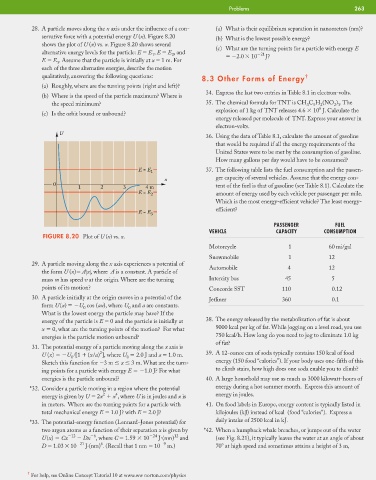
                         shows the plot of U (x) vs. x. Figure 8.20 shows several
                                                                              (c) What are the turning points for a particle with energy E
                         alternative energy levels for the particle: E   E , E   E , and    2.0   10  21  J?
                                                           1
                                                                2
                         E   E . Assume that the particle is initially at x   1m. For
                              3
                         each of the three alternative energies, describe the motion
                         qualitatively, answering the following questions:  8.3 Other Forms of Energy    †
                         (a) Roughly, where are the turning points (right and left)?
                                                                           34. Express the last two entries in Table 8.1 in electron-volts.
                         (b) Where is the speed of the particle maximum? Where is
                            the speed minimum?                             35. The chemical formula for TNT is CH C H (NO ) . The
                                                                                                              2
                                                                                                         3
                                                                                                           5
                                                                                                                  2 3
                                                                                                             6
                                                                              explosion of 1 kg of TNT releases 4.6   10 J. Calculate the
                         (c) Is the orbit bound or unbound?
                                                                              energy released per molecule of TNT. Express your answer in
                                                                              electron-volts.
                              U
                                                                           36. Using the data of Table 8.1, calculate the amount of gasoline
                                                                              that would be required if all the energy requirements of the
                                                                              United States were to be met by the consumption of gasoline.
                                                                              How many gallons per day would have to be consumed?
                                                          E
                                                      E =   1              37. The following table lists the fuel consumption and the passen-
                                                              x               ger capacity of several vehicles. Assume that the energy con-
                             0
                                    1      2      3      4  m                 tent of the fuel is that of gasoline (see Table 8.1). Calculate the
                                                          E
                                                      E =   2                 amount of energy used by each vehicle per passenger per mile.
                                                                              Which is the most energy-efficient vehicle? The least energy-
                                                                              efficient?
                                                      E =   3
                                                          E
                                                                                                PASSENGER         FUEL
                                                                            VEHICLE             CAPACITY       CONSUMPTION
                         FIGURE 8.20 Plot of U (x) vs. x.
                                                                            Motorcycle              1           60 mi/gal
                                                                            Snowmobile              1           12
                      29. A particle moving along the x axis experiences a potential of
                                                                            Automobile              4           12
                         the form U (x)  A x , where  A is a constant. A particle of
                         mass m has speed v at the origin. Where are the turning  Intercity bus    45            5
                         points of its motion?                              Concorde SST          110            0.12
                      30. A particle initially at the origin moves in a potential of the  Jetliner  360          0.1
                         form U(x)   U cos (ax), where U and a are constants.
                                      0            0
                         What is the lowest energy the particle may have? If the
                         energy of the particle is E   0 and the particle is initially at  38. The energy released by the metabolization of fat is about
                         x   0, what are the turning points of the motion?  For what  9000 kcal per kg of fat. While jogging on a level road, you use
                         energies is the particle motion unbound?             750 kcal/h. How long do you need to jog to eliminate 1.0 kg
                                                                              of fat?
                      31. The potential energy of a particle moving along the x axis is
                                           2
                         U (x)   U  [1   (x/a) ], where U   2.0 J and a   1.0 m.  39. A 12-ounce can of soda typically contains 150 kcal of food
                                  0                0
                         Sketch this function for  3 m   x   3 m. What are the turn-  energy (150 food “calories”). If your body uses one-fifth of this
                         ing points for a particle with energy E    1.0 J? For what  to climb stairs, how high does one soda enable you to climb?
                         energies is the particle unbound?                 40. A large household may use as much as 3000 kilowatt-hours of
                     *32. Consider a particle moving in a region where the potential  energy during a hot summer month. Express this amount of
                                               4
                                            2
                         energy is given by U   2x   x , where U is in joules and x is  energy in joules.
                         in meters. Where are the turning points for a particle with  41. On food labels in Europe, energy content is typically listed in
                         total mechanical energy E   1.0 J? with E   2.0 J?   kilojoules (kJ) instead of kcal  (food “calories”). Express a
                     *33. The potential-energy function (Lennard–Jones potential) for  daily intake of 2500 kcal in kJ.
                         two argon atoms as a function of their separation x is given by  *42. When a humpback whale breaches, or jumps out of the water
                                         6
                                                                 12
                         U(x)   Cx  12    Dx , where C   1.59   10  24  J
(nm) and  (see Fig. 8.21), it typically leaves the water at an angle of about
                                           6
                         D   1.03   10  21  J . (nm) . (Recall that 1 nm   10  9  m.)  70  at high speed and sometimes attains a height of 3 m,

                     †  For help, see Online Concept Tutorial 10 at www.ww norton.com/physics

