


Page 91 - Fisika Terapan for Engineers and Scientists
P. 91
9.5  Energy in Orbital Motion                        291


                                                      2
                                                         2
                                                                     24
                                      6.67   10  11   N m /kg   5.98   10 kg   1300 kg

                                                            2
                                             1             1
                                      ¢         7             6   ≤
                                        4.23   10 m   6.65   10 m
                                             10
                                     3.29   10  J
                        This energy was supplied by the booster rocket of the satellite.


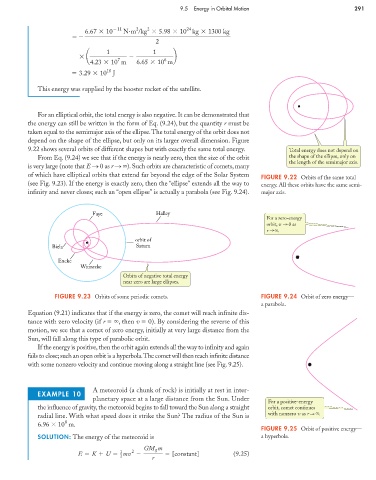
                        For an elliptical orbit, the total energy is also negative. It can be demonstrated that
                     the energy can still be written in the form of Eq. (9.24), but the quantity r must be
                     taken equal to the semimajor axis of the ellipse.The total energy of the orbit does not
                     depend on the shape of the ellipse, but only on its larger overall dimension. Figure
                     9.22 shows several orbits of different shapes but with exactly the same total energy.  Total energy does not depend on
                        From Eq. (9.24) we see that if the energy is nearly zero, then the size of the orbit  the shape of the ellipse, only on
                                                                                                    the length of the semimajor axis.
                     is very large (note that E S 0 as r S  ). Such orbits are characteristic of comets, many
                     of which have elliptical orbits that extend far beyond the edge of the Solar System  FIGURE 9.22 Orbits of the same total
                     (see Fig. 9.23). If the energy is exactly zero, then the “ellipse” extends all the way to  energy. All these orbits have the same semi-
                     infinity and never closes; such an “open ellipse” is actually a parabola (see Fig. 9.24).  major axis.


                                        Faye                Halley
                                                                                             For a zero-energy
                                                                                             orbit, v      0 as
                                                                                             r      .
                                                      orbit of
                            Biela                     Saturn
                              Encke
                                     Winnecke
                                                  Orbits of negative total energy
                                                  near zero are large ellipses.

                             FIGURE 9.23 Orbits of some periodic comets.                    FIGURE 9.24 Orbit of zero energy—
                                                                                            a parabola.
                     Equation (9.21) indicates that if the energy is zero, the comet will reach infinite dis-
                     tance with zero velocity (if r   , then v   0). By considering the reverse of this
                     motion, we see that a comet of zero energy, initially at very large distance from the
                     Sun, will fall along this type of parabolic orbit.
                        If the energy is positive, then the orbit again extends all the way to infinity and again
                     fails to close;such an open orbit is a hyperbola.The comet will then reach infinite distance
                     with some nonzero velocity and continue moving along a straight line (see Fig. 9.25).


                                         A meteoroid (a chunk of rock) is initially at rest in inter-
                        EXAMPLE 10
                                        planetary space at a large distance from the Sun. Under
                                                                                              For a positive-energy
                        the influence of gravity, the meteoroid begins to fall toward the Sun along a straight  orbit, comet continues
                        radial line. With what speed does it strike the Sun? The radius of the Sun is   with nonzero v as r      .
                                8
                        6.96   10 m.
                                                                                            FIGURE 9.25 Orbit of positive energy—
                        SOLUTION: The energy of the meteoroid is                            a hyperbola.
                                                        GM m
                                                           S
                                                 1
                                                    2
                                    E   K   U   mv              [constant]         (9.25)
                                                 2        r

