


Page 92 - Fisika Terapan for Engineers and Scientists
P. 92
292                                CHAPTER 9  Gravitation


                                                      Initially, both the kinetic and potential energies are zero (v   0 and r    ). Hence
                                                      at any later time
                                                                                   GM m
                                                                            1 mv      S     0
                                                                                2
                                                                                      r
                                                                            2
                                                      or
                                                                                     GM m
                                                                              1  2      S
                                                                               mv                                (9.26)
                                                                                        r
                                                                              2
                                                      If we cancel a factor of m and multiply by 2 on both sides of this equation, take
                                                      the square root of both sides, and substitute r   R for the impact on the Sun’s
                                                                                               S
                                                      surface, we find the speed at the moment of impact:
                                                                                     2GM
                   impact speed and escape velocity                            v         S                       (9.27)
                                                                                   A R
                                                                                        S
                                                                        30
                                                                                                         8
                                                      With M   1.99   10 kg (see Example 4) and R   6.96   10 m, we obtain
                                                             S
                                                                                              S
                                                                                                       30
                                                                                       2
                                                                                           2
                                                                    2   6.67   10   11  N m /kg   1.99   10 kg
                                                              v
                                                                  B               6.96   10 m
                                                                                          8
                                                                          5
                                                                  6.18   10  m/s   618 km/s
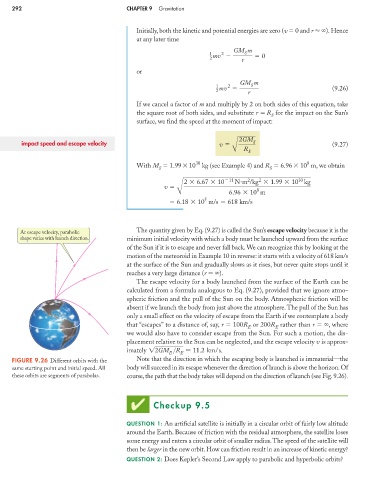
                  At escape velocity, parabolic       The quantity given by Eq. (9.27) is called the Sun’s escape velocity because it is the
                  shape varies with launch direction.  minimum initial velocity with which a body must be launched upward from the surface
                                                   of the Sun if it is to escape and never fall back. We can recognize this by looking at the
                                                   motion of the meteoroid in Example 10 in reverse: it starts with a velocity of 618 km/s
                                                   at the surface of the Sun and gradually slows as it rises, but never quite stops until it
                                                   reaches a very large distance (r    ).
                                                      The escape velocity for a body launched from the surface of the Earth can be
                                                   calculated from a formula analogous to Eq. (9.27), provided that we ignore atmo-
                                                   spheric friction and the pull of the Sun on the body. Atmospheric friction will be
                                                   absent if we launch the body from just above the atmosphere.The pull of the Sun has
                                                   only a small effect on the velocity of escape from the Earth if we contemplate a body
                                                   that “escapes” to a distance of, say, r   100R or 200R rather than r   , where
                                                                                        E       E
                                                   we would also have to consider escape from the Sun. For such a motion, the dis-
                                                   placement relative to the Sun can be neglected, and the escape velocity v is approx-
                                                   imately 12GM >R    11.2  km/ s.
                                                                E
                                                                   E
                FIGURE 9.26 Different orbits with the  Note that the direction in which the escaping body is launched is immaterial—the
                same starting point and initial speed. All  body will succeed in its escape whenever the direction of launch is above the horizon. Of
                these orbits are segments of parabolas.  course,the path that the body takes will depend on the direction of launch (see Fig.9.26).


                                                    ✔      Checkup 9.5


                                                   QUESTION 1: An artificial satellite is initially in a circular orbit of fairly low altitude
                                                   around the Earth. Because of friction with the residual atmosphere, the satellite loses
                                                   some energy and enters a circular orbit of smaller radius.The speed of the satellite will
                                                   then be larger in the new orbit. How can friction result in an increase of kinetic energy?
                                                   QUESTION 2: Does Kepler’s Second Law apply to parabolic and hyperbolic orbits?

