


Page 110 - NAVAL SCIENCE 3 TEXTBOOK
P. 110
INTERNATIONA L  LAW AND THE SEA   115

                                                                   Deln)' in  taking appropriate disciplinary action brings resent-
                                                                ment toward the entire system- especially if the offender "gets off
                                                                because of a time Inpse that dulls memories or makes it seem  ns
                                                                though the offense hns been overlooked. \ Vrong Olcts and poor per-
                                                                (onmmce require immediate guidance and correction  in order to
                                                                bring about the necessaqr changes.
                                                                   New leaders l11a)' have a tendency to be too lenient with minor
                                                                infractions,  thereby penalizing good  people  while  favoring  bad
                                                                ones. \Vhen this error is pointed out to some junior leaders, they
                                                                mily become uncert<lin of thelllseives, and in trying to compensate
                                                                for  the tilUlt, they overreact, becoming too nrbitrary. In  either case
                                                                the leader will lose the confidence of subordinates because of such
                                                                inconsistency. It is best to chart a steady course when denling with
                                                               disciplinary matters.
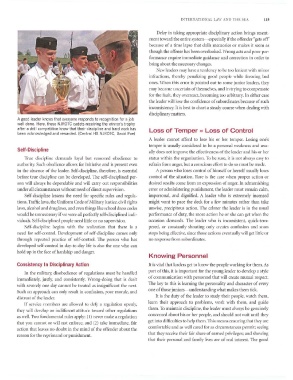
         A good  leader knows that everyone responds to recognition for a job
         well  done.  Here, these NJROTC cadets receiving the winner's trophy
         after a dril l competition  know that their discipline and  hard work has   Loss of Temper = Loss of Control
         been  acknowledged  and  rewarded.  (Central  HS  NJROTC, David  Poe)
                                                               A leader cannot  afford  to  lose  his or  her  temper.  Losing  one's
                                                               temper is  usually considered to be a personal  weakness and  usu-
         Self-Discipline
                                                               ally does not improve the effectiveness of the leader and his or her
           True  discipline  demands  loyal  but  rensoned  obedience  to   status within the organization. 'tb be sure, it is  not always eas), to
         authority. Such obedience allows for  initiath'e and is present even   refrain from anger, but a consciolls eftort to do so must be made.
         in  the absence of the  leader. Self-discipline, therefore, is essential   A person who loses control of himself or hersclf usunlly loses
         before true discipline can be de\'eloped. The self-disciplined  per-  control  of the situiltion.  Rare is the  cnse  when  proper action  or
         SOil  will  always  be  dependable and  will  cury out  responsibilities   desired results come from an expression of anger.  In admonishing
         under all circumstances without need of direct supervision.   error or ndministering punishment, the leader IllllSt  remain calm,
           Self-discipline  lessens the  need  for  specific rules and  regula-  impersollnl, and  dignified.  A leader  who  is extremely  incenscd
         tions. Traffic laws, the Uniform Code of Militar}' Justice, civil rights   might  want to pace  the deck  for  a few  minutes  rather than  take
        lnws, alcohol and drug laws, and cvell things like school dress codes   unwise, precipitolls actioll. The calmer the  leilder  is in  the  usual
        would be unnecessary if we wt.:Te all perfectly self-disciplined indi-  performance of duty, the more action he or shc can  get when the
        viduals. Self-disciplined people need little or no supervision.   occnsiull  demands.  The  leader  who  is  inconsistcnt,  quick-tem-
           Self-discipline  begins  with  the  realiz;.ltion  that  there  is  a   pered,  or  constantly shollting  only creates confusion  and  soon
         Ileed  for  self-control.  Development of self-discipline comes only   stops being effective, sincc those actions e,'entunll}, will get little or
        through  repeated  prilctice  of self-control.  The  person  who  has   no response from subordinates.
        developed self-control  in da),-to-day life  is also  the one who can
        hold up in the tace of hardship and danger.
                                                               Knowing Personnel

        Consistency  In Disciplinary Action                    It is vital  that leaders get to know the people working for them. As
                                                               part of this, it  is importnllt for  the young leader to develop a style
            In the  military,  disobedience of regulatiolls must  be hnndled
                                                               of communication with personnel  thnt will creilte mutual  respect.
        immediatciy,  justly,  and  consistently.  \Vrong*doing  thnt  is dealt
                                                               The key to this  is learning the personality and chnracter of every
        with scverely one day cannot be treated  ilS  insignificant the next.
                                                               one of those juniors- understanding what makes thcm tick.
        Such an approach can only result in  confusion, poor morale, and
                                                                  It is the duty of the leader to stud), their people, watch  them,
        distrust of the leader.
                                                               learn  their  nppronch  to  problems,  work  with  them,  nlld  guide
           If service  members are  allowed  to  de~'  a regulation  opcnly,
                                                               them. To  Illnintnin discipline, the leader must always be genuinely
        they will  develop an indiftcrent attitude toward other regulations
                                                               concerned about his or her people, Olnd  should not wait until they
        as well. Two fUlldnmental rules apply:  (1) never make a regulation
                                                               get into difficulties to help them. This means ensuring that they arc
        that you canllot or will  not cnforce,  nnd (2)  take immediate, filiI'
                                                               comlortable and as well  cared for OlS  circllmst;'lI1Ces permit; seeing
        action  thnt leaves no doubt in  thc mind of the offender about the
                                                               thnt  they receive their f..li r share of earned privileges; o.llld shmving
        n.~aso n for the reprimand or punishment.
                                                               thnt their  personal Olnd  f..l111 ily lives  are of reill  interest. The good

