


Page 114 - NAVAL SCIENCE 3 TEXTBOOK
P. 114
INTERNATIO NAl. I.AW AND TilE SEA 119
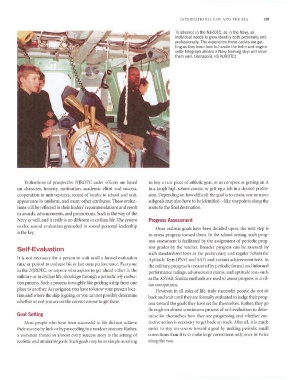
To advance in the NJROTC, as in the Navy, an
individual needs to grow steadily both personally and
professionally. The experience these cadets are get-
ting as they learn how to handle the helm and engine
order telegraph aboard a Navy training ship will serve
them well. (Annapolis HS NJROTC)
Evaluations of prospective NJROTC cadet officers nrc based to buy a Ilew piece of athletic gear, or as complex as getting an A
0 11 character, honesty, motivation, academic effort nnd success, in a tough high school course, or getting a job in a desired protes-
cooperation in ullit ventures, record of loynlt)' to school and unit, sian. Depending 011 how difficult the goal is to attain, one or more
appeilrance in uniform, and mi1l1)' other i.lttributes. These e"nluk subgoals may also ha\'e to be identified- like waypoints along the
tions will be renected in their leaders' recommendations and result route to the final destinatioll.
in awards, nd\·i.1IlCements, and promotions. Such is the way of the
Nnv}' as well, and it really is no different in civilian life. The system Progress Assessment
works; sOllnd evaluation grounded in sound personal leadership
Once realistic goals ha\'e been decided upon, the next step is
is the key.
to assess progress toward them. In the school setting, such prog-
ress assessment is facilitated by the assignment of periodic prog-
Self -Evaluation ress grades by the teacher. Uroader progress can be assessed by
such standardized tests as the preiiminnl"}' and regular Scholastic
It is not necessnry for a person to wait until a formal evaluation
Aptitude Tests (PSAT and SAT ) and vnrious achievement tests. In
timc or period to evaluate his or her 0\\,11 performance. Everyone
the military, progress is measured by periodic formal and int<mnai
in the NjROTC, or anyone who aspires to get ahcad either in the
performance filtings, advancement exams, and aptitude tests such
militnry or in civilian life, should go through a periodic .~I!If-e\l{lll1tl
as the ASVAll. Similar methods are used to assess progress in civil-
I iOI/ process. Such a process is roughly like guiding a ship from one
ian occupations.
place to another. As navigator, you have to know your presellt 10Gt-
However, in all roles of life, truly successful peoplc do not sit
tion and where the ship is going, or you canllot possibly determine
back and wait until they are formall), e\'aluated to judge their prog-
whether or not YOli arc on the correct course to get there.
ress tow;.ud the goals they have set for themselves. Rather, they go
through an almost continuous process of self-evaluation to deter-
Goal Setting mine lo r themseh'es how they are progressing and whether cor-
;"Iost people who have been successful in lite did not achieve rective action is necessary to get back on track. After all, it is much
their Sllccess by luck or by proceeding in a random manner. Rather, easier to stay on course toward a goal b}' making periodic small
a common thread in al most every success stor), is the setting of corrections than it is to make large corrections only once or h\'ice
realistic and attainable gonls. Such goals may be as simple as saving along the Wity.

