


Page 113 - NAVAL SCIENCE 3 TEXTBOOK
P. 113
II Evaluation of Performance


         All  people  are  involved  in  evaluation  from  illl  carly  age.  Babies   llation were right. Further out in  lime, it might sometimes refer to
         respond  to  some  types  of  personalities  better  than  others.   potential  performnnce.  tor example, a long-distance rullner may
         YOllngsters select friends based 011  performance and satist)'illg their   be hampered in a particulnr race by illness, but basic ability is not
         needs for companionship. The process becomes more sophisticated   qucstioned. One often he<lrs comments on potential performance
         and  important as  years  go  by.  In  the  Na\T and  in  NJROTC. offi-  such as, "He could do it ifhe renll)' tried," or "She just doesn't seem
         cers are concerned with the selection of personnel  for  instructors,   to care." In  the final  nllalysis,  true ability cnHnot be judged except
         for  school  nominations, for  advancement  in  rale, for  filling billets   b)' observing performance. It is the results thnt count!
         in  the unit, and for carrying out specific  assignments. The overall   Both  performance ;:1I1d  ability  refer to the  present-wh;:l1  the
         pcrformill1cc rating of a naval leader is greatly afiixted by ability to   person  is  doing, or can  do.  now.  Aptitude,  on  the other  hand,
         select appropriate people for various roles, and to judge their C<lpa-  refers to potential skills nnd abilities  in  the  future.  Aptitude tests
         bilit)' tu take on future assignments of greater responsibility.   of many varieties, such as the SAT (Scholastic Aptitude Test)  nnd
                                                               ASVA13  (an  armed  services  aptitude  test),  as  wdl as  evaluation
                                                               of background  expcriences,  can  be  used  with  good  reliability  to
         Performance, Ability, Aptitude,                       select individuals  for  training in  certain areas.  For example,  high
         Achievement                                           school ll1l1sicians proved to be ver)' adept radiomen in \Vorld \Var

         PCljo/"ma/lce  refers  to  what  a  person  does-actual behavior  or   II,  when  <Ill  individual's  ability  to  read  international Morse  code
         actual output. Ability is often confused  with  performance. Ability   was crucial  to  the rating.  Likewise.  the  I;mnhand who Ims  driven
         often applies to performance over a considerable period of time; it   and repaired  tractors, cnrs, and mnchinery since age ten  is il good
         also applies to what a person could do at a given moment, if the sit-  prospect to become <I sllccessful enginel1l<lll or machinist's Illate. A
                                                               long list of such examples could be Illade.
                                                                  Aciliel'elllent generi.\lIy refers to performance in  the past, often
                                                               that  which  has  alre;:ldy  been  eVi.lluated.  Achievement  applies  to
                                                               work that has been done. \"hen properly evaluated. past achieve-
                                                               ments of individuals in the same field cnn be quickly compared for
                                                               selection for  promotion or future job assignments. Properl)! eval-
                                                               uating the achievcments of their subordinates is one of the  most
                                                               important responsibilities of a leader.


                                                               Evaluation in the NJROTC

                                                               Developing  leadership  ability  is  one  of the  main  objectives  of
                                                               N]ROTC. Students enrolled in this course should strive to become
                                                               leaders  in  their  school.  unit,  and  community.  and  prepare  for
                                                               higher leadership roles later in life.
                                                                  Already.  the  cadet  officers  of an  NJROTC  unit  have  been
                                                               through  a selection  process  to  attain  their  ranks  and  their  posi-
                                                               tions. Their predecessors  undoubtedly helped  their naval science
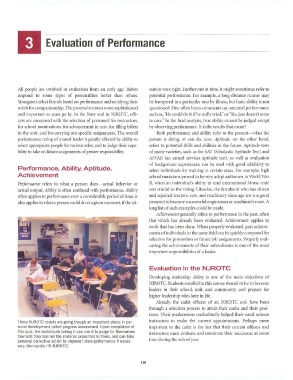
        These  NJROTC cadets are going though an  important phase  in  per-  instructors  to  make  the  current  appointments.  Perhaps  more
         sonal development cal led progress assessment.  Upon completion of   important to  the  cadet  is  the fact  that  their  current  oll1cers  and
         this quiz, the individuals taking it can  use it to judge for themselves   instructors must evaluate ilild  nominate  their successors at  some
         how well  they learned  the material presented  to them, and can  take
                                                               time during the school year.
         personal corrective action to improve future  performance  if neces-
        sary.  (Annapolis HS  NJROTC)


                                                            118

