


Page 117 - NAVAL SCIENCE 3 TEXTBOOK
P. 117
122     LEADERS HIP


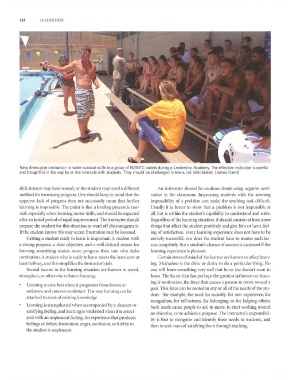
          Navy divers give  instruction  in  water survival  skills to a group of NJROTC cadets during a Leadership Academy.  The effective instructor is careful
         and  thoughtful  in  the  way  he or she  interacts with  students.  They should  be  challenged to learn,  not  intimidated.  (James Foehl)


         skill; interest mily hilve wilned; or the student may need a diA-erent   An  instructor should  be cautiolls about using  Ilcgntil'c  /1lOtj-
         method for incrc;:lsing progress. Olle should  keep in mind that the   1'(1(;011  in  the  classroom.  Impressing  students  with  the  seeming
         apparent lack of progress does  not necessarily mcan  that further   impossibility  of a  problem  can  make  the  teaching  task  difficult.
         learning is impossible. The point is  that a le\'eling process  is  nor-  Usually  it  is  better  to  show  that  i1 problem  is  not  impossible  ::It
         mal, especially when learning 1110tor skills, ::Ind should be expected   all, but is  within the student's capability to understand and so"'e.
         nltcr iln initial period of rapid improvcment. The instructor should   Regardless of tht.:  learning situation, it should contain at least some
         prepare the student fa]'  this situation to ward otT discouragement.   things that affect the student positively and give him or her a feel-
          If the student knows this may occur, frustriltion 111<l}' be lessened.   ing of satisf<lction.  Every  learning experience docs not ha\'e to  be
            Getting a student ready to learn  is  important.  A student with   entirely successful. nor docs the student have  to  master each les-
         a strung purpose, i1  clear objective, and a wcll-ddillcd reason for   son completely. But a studt.'nt's ch"lllce of Sllccess is increased if the
         learning  something  makes  more  progress  than  one  who  lacks   learning experiellCe is pleasant.
         motivation. A student who is ready to learn meets the instructor at   Certain states of mind of the learner are known to affect learn-
         least halfw<lY, and this simplifies the illstl'llctor's job.   ing.  Motil't1tioll  is the drive or desire  to  do a particular thing.  No
            Several  t~lCtorS in  the learning situation  are  known  to speed,   one will  learll somcthing very well  that he or she doesn't want  to
         slrel1glhe11. or othen\'ise ellilance learning:        learn. The t~lCtor that has perhaps the greatest inOuence on learn-
                                                                ing is  motivation. the fo)'(.:('  that causes <l  person to move toward a
            Learning occurs best when it progresses from kllOIl'1I to
                                                                goal. This force can be rooted in allY or all of the necds of the stu-
            /II/kIWII'll and col/crete to nbstmct. The new learning can be
                                                                dent- fo r example. the lleed  for security.  for new experience,  fa r
            attached to areas of existing knowledge.
                                                                recogn ition, tar self-esteem. for  belonging. or for  helping others.
            Learning is strengtht.:Jled  whell accompanied by a pleasant or
                                                                Such needs C<luse  people to act, to  movc, to start working toward
            satis~'illg feeling, and learning is weakened when it  is associ-
                                                                an objective, or to achieve a purpose. The instl'llctor's responsibil-
            ated with all 1I1lpleasilnt fix'iing. An experience that produces
                                                                ity is  first to  recognize  and  identi~'  thcse  needs  in  students, and
            feeli ngs of defeat, ti'ustratioll, anger, confusion, or filtility in
                                                                then to seek WilYS of siltis~'i ng them through teaching.
            the student is unpleasant.

