


Page 116 - NAVAL SCIENCE 3 TEXTBOOK
P. 116
II How to Give Instruction


        As  YOli  become  an  upperclassman  in  your  school and  achieve
        higher ranks within  your NJROTC  units, you will often be called
                                                                        50
        upon to give either formal or informal instruction to schoolmates
        or to junior NJROTC cadets. In  this chapter we  will  discllss  man)'
                                                                         0
        things that will be helpful when YOll find  yourself in  this situation.   --------  ~
        These  include  leaning  theory,  preparation  for  instruction, and   0
        techniques for delivery.                                                         \
                                                                         0
                                                                                           ~
        Learning Theory                                                  0

        The good instructor is Ilmster of m<1ny skills.  Successful  instruc-  o
        tion demands competence in the subject matter and knowledge of    o  10  W  m  ~  m ~  ro  w ~ 100
        teaching skills.  Utlt the methods of instruction depend  largel),  011     Number of Trials
        an understanding of how people IL'nrn and the ability to apply that
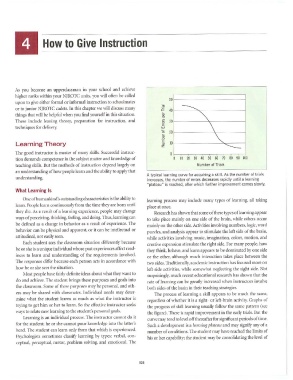
                                                               A typical  learning curve for acquiring a ski ll.  As the  number of trials
        understanding.
                                                               increases,  the  number of errors decreases rapidly until a learning
                                                               "plateau"  is reached, after which further improvement comes slowly.
        What Learning Is
           One of humankind's outstanding characteristics is the abilit}, to
                                                               learning  process  may  include  many types  of learning, ali  taking
        learn. People learn continuously from the time they are born until
                                                               place at once.
        they  die.  As  a result of a learning experience, people mily change   Research has shown that some of these types of learning appear
        ways of perceiving, thinking, feeling. and doing. Thus, learning can   to take place  mainly on one side of the brain, while others OCCllr
        be defined as a change  in  behavior as a result  of experience. The   mainly on the other side. Activities involving numbers, logic, word
        behavior can be physical ilnd apparent, or it c;m  be intellectual or   puzzles, alld analysis appear to stimulate the left side of the bmin,
        attitudinal, not easily seen.                          while activities  involving music, imagination, colors,  motion, i1l1d
           Each student sees the classroom situation diA-erently because   creative expression stimulate the right side. For many people, how
        he or she is a unique individual whose past experiences aftec!  read-  they think, behave, and leaJ'Jl appears to be dominated by one side
        iness  to  learn  and  understanding  of the  requirements invol\'ed.   or the other, although much  interaction takes place  between the
        The responses difter because each person acts in  accordance with
                                                               two sides. Traditionali}', academic instruction has focused Illore 011
        how he or she sees the situation.                      left-side  activities, while somewhat neglecting the right side.  Not
           Most people have fairly definite ideas about what they want to   surprisingly, much recent educational research has shown that the
        do and achieve. The student brings these purposes and goals into   rate of learning can be greatly increased when instructors in\'olve
        the classroom. Some of these purposes may be persona!, and oth-  both sides of the brain in their teaching strtltegies.
        ers mny be  shnred with  classmates.  Individual needs  may deter-  The process of learning a skill  appears to  be much the same,
        mine what  the student  learns  as  much  as  what the instructor is   regardless of ",hether it is a right- or left-brain nctivity.  Graphs of
        tr)'ing to get him or her to learn. So  the eftective instructor seeks   the progress of skilliearnillg usually foliow the same pattern (see
        ways to relate new learning to the student's personal goals.   the figure). There is rapid impro\'ement in  the endy trials.  ilut the
            Learning is an  individual process. The instructor cannot do it   clll've may tend to level off thereafter for significant periods of time.
        for the student; he or she cannot pour knowledge into the latter's   Such a development is il leamillg plateali and ma}' signify all}' of a
        head. The student can learn  only from  that which is experienced.   number of conditions. The student may have reached the limits of
        Psychologists  sometimes classify  learning  by  types:  verbal,  COI1 -  his or ht'r capability; the student may be consolidating the level of
        ceptual, perceptual, IllataI',  problem solving,  and  emotionnl. The


                                                            121

