


Page 123 - NAVAL SCIENCE 3 TEXTBOOK
P. 123
128     LEADERSH I P

            Step  three:  performance. The  performance step  is the  step  in   Role  pillying  provides  insight  into  cOlllmon  individual and
         which  the  students  practice  under  supelyision  untiJ they  have   group problems. reveals different attitudes, and  tests vllrious ideas
         attained the required proficienC)l. During this step, they apply what   in a practical situation. Students  learn  to  organize  thoughts and
         they have previously learned as a result of the demonstrations.   responses instantly while reacting to a situation or question.
            Guidelines  for  effective  use  of  the  demonstration.  Practice  or   Disadvantages.  Students  sometimes  emphasize  perfornllll1ce
         rehearse the demonstration in its entirety with an eye on time lim-  (showing off) over the intended objectives of the topic. Role play-
         itations. \Vhen  it  is time to  put on the demonstration. make sure   ing is  time-consuming. Some students are unable to  identi~' with
         that all  materials are at hand. Make sure that the students are situ-  the roles or situation.  Hot  topics and  controversial issues  some-
         .. lied such that all can sec and hear. Use questions during the dem-  times  get  out of hand  in  role playing.  Role  playing  ma)'  benefit
         onstration  to  obtain  feedback.  At the end of the demonstration,   only the Ilctllal participants unless the objectives for the class have
         conduct it brief review of the steps involved or a short summary of   been clearl), specified.
         what has happened.
                                                                Case Study
         Role Playing
                                                                   The case study is an  instructional approach  that  requires the
            Role pla)'ing  is  an  instructionlll  technique  involving a spon-  student to analyze problem situations that  may be  hypotheticlll or
         taneous  porlm),'.ll (acting  out)  of a situation. condition. or cir-  relli. The student receives a "case"-a report containing 0:111  pertinent
         cumstance  by  selected  members  of  the  class.  It  is  a  form  of   data. The student then must analyze the data, e"aIullte the 1l000ture of
         improvisation  in  which  the participants  assume  the  identity  of   the problem. decide upon applic<1ble principles. Ilnd finllUy recom-
         other persons and then fellct as they believe those persons would   mend a solution or course of action. The case 111<1)' be handled  by
         in a particular situation. Role playing is especially useful in helping   the class as a whole. by subgroups of the class. or by <1n  individual.
         students understalld perspectives and different ethllic and cultural   Also,  the case may be designed to  be handled in  varied time peri-
         backgrounds,  and  in  problem-solving situations  where  different   ods, ranging from a single class period to the entire course.
         roles are in opposition to each other. Role playing is often effective   Analysis of the data involves sllch things as the usc of reference
         in counseling or tutoring.                             materials prepared for  the study, or knowledge and theory already
            Advantages.  Role  playing  Gill  be  fun,  interesting,  motivating,   possessed  by others and  listed  in  manuals and books.  Evaluating
         Ilnd meaningful, and helps to break the routine of other classroom   and determining applicable  principles calls  upon  the students  to
         experiences.


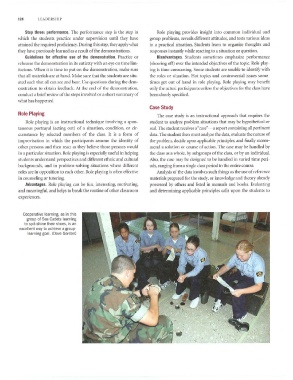
           Cooperative learning, as in this
            group of Sea Cadets learning
           to spit-shine their shoes,  is an
         excellent way to achieve a group-
             learning goal.  (Dave Gordon)

