


Page 122 - NAVAL SCIENCE 3 TEXTBOOK
P. 122
INTERNATIONAL LAW AND  THE  SEA    127


                                                                Others should normally be presented in the actual environment or
                                                                l<lboratories, in conjunction with demonstrations.
                                                                   Position the students and training aids properly I f the instruc-
                                                                tor directs the students to gather around a worktable or a training
                                                                aid,  he should recheck their positioning to  make  sure that ever},-
                                                                one has an ullobstructed view.
                                                                  Show  and  explain  the  operations.  Perform  the  operations  in
                                                               step-by-step  order.  Wherever possible, simultaneollsly tell  and  do.
                                                                Do not hurry;  speed  in performing operi.ltions, or in moving from
                                                               one operation to another, should normally not be emphasized in the
                                                               demonstration step. The instructor should make cert<lin that the stu-
                                                               dents understand the first step before he or she proceeds to the sec-
                                                               ond, and so on. Repeat difficult operations. Pause briefly after each
                                                               operation to observe reactions <lnd to check for understanding.
                                                                  Special  mention should be made of skills in  which  a distinc-
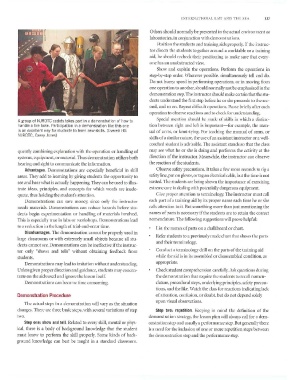
        A group of NJROTC cadets takes part in  a demonstration of how  to
         handle a fire  hose. Participation  in  a demonstration like this one   tion between  right and left is  important-for eXilmple,  the man-
         is an  excellent way for students to  learn  new skills. (Everett HS   ual  of arms,  or knot-tying. For  teach ing  the  manual of arms,  or
         NJROTC,  Casey Jones)
                                                               skills of a similar nature, the use of an assistant instructor or a \\'e1l-
                                                               coilChed student is advisable. The assistant stands so that the class
        qucntly combining explanation with the operation or handling of   may see  what he or she  is doing and  performs the activity at the
        systems, equipment, or material. Thus demonstration utilizes both   direction of the instructor.  Meanwhile, the instructor can observe
        hearing and sight to cOlllmunicate the information.    the reaction of the students.
           Advantages.  Demonstrations  are  especially  beneficial  in  skill   Observe salety precautions. It takes a few Illore seconds to rig a
        areas. They add to  learning by giving students the opportunity to   satet)' line, put on gloves, or tag an electrical cable, but the time is not
        see and hear what is actually happening. They can be used to illus-  wasted. The students are being shown the importance of exercising
        trate  ideas,  principles,  and  concepts  for  which  words  are  inade-  extreme care ill dealing with potentially dangerous equipment.
        quate, thus holding the student's attention.              Give proper attention to terminology. The instructor must call
           Demonstrations  can  save  money,  since  only  the  instructor   each part of a training aid by its proper name each time he or she
        needs  materials.  Demonstrations can  reduce  hazards before  stu-  calls attention to it.  But something more than just mentioning the
        dents  begin  experimentation  or  handling  of materials  involved.   names of parts is  necessary if the students are to  retain the correct
        This is especially true in  tabs  or workshops. Demonstrations lead   nomenclatl\l'e. The following suggestions will prove helpful:
        to a reduction in the length of trial-and-error time.
                                                                  List the names of parts on a chalkboard or chart.
           Disadvantages.  The demonstration cannot be properly used in
                                                                  Refer students to a previously made chart that shows the parts
        large classrooms or with  extremely small  objects  because  all  stu-
                                                                  and their terminology.
        dents cannot see. Demonstrations can be ineffective if the instruc-
        tor  only  "shows  and  tells"  without  oblaining  feedback  ti'OIll   Conduct a terminology drill on the parts of the training aid
        students.                                                 while the aid is in its assembled or disassembled condition, as
                                                                  appropriate.
           Demonstrations m<1y lead to imitation without understanding.
        Unless given proper direction ilnd guidance, students may concen-  Check student comprehension carefully. Ask questions duri ng
        Irate on the <lids used and ignore the lesson itself.     the demonstration that require the students to recall  nomen-
           Demonstrations can become time consum ing.             clature, procedural steps, underlying principles, safety precau-
                                                                  tions, and the like. \Vatch the class for reactions indicating lack
        Demonstration Procedure                                   of attention, confusion, or doubt, but do not depend solei),
                                                                  upon visual observations.
           The actual steps  in  a demonstration "'ill vaq' as the situation
        changes. There are three basic steps, with several variations of step   Stell  two:  repetition.  Keeping  in  mind  the  definition  of the
        two.                                                   demonstration strateg)"  the lesson plan will always call  for a dem-
           Step  one:  show  and  tell.  Related  to ever), skill,  melltal or phys-  onstration step and usually a performance step. But genel'<lU)' there
        ical,  there  is  a  body of b<lCkground  knowledge  that the student   is a need for the inclusion of one or more repetition steps between
        must  know  to  perform  the  skill  properly.  Some kinds  of back-  the demonstration step and the performance step.
        ground  knowledge  can  best  be  taught  in  a  standard  classroom.

