


Page 120 - NAVAL SCIENCE 3 TEXTBOOK
P. 120
il\'TERNATlONAL  LAW  AND  THE  SEA   125


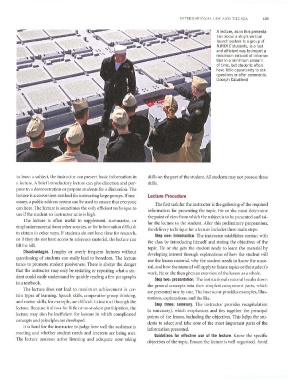
                                                                                            A lecture,  as  in  this presenta-
                                                                                           tion  about a ship's vertical
                                                                                            launch  system  to  a group of
                                                                                            NJROTC students,  is a fast
                                                                                           and efficient way  to  impart a
                                                                                           maximum amount of informa-
                                                                                           tion  in  a minimum amount
                                                                                           of time,  but students often
                                                                                           have  little opportunity to ask
                                                                                           questions or offer comments,
                                                                                           (Joseph  Caballero)


        to learn a subject, the instructor can present  basic information in   skills on the part of the student. All students may not possess these
        a lecture, A brief introductory lecture can give direction and pur-  skills.
        pose to a demonstration or prepare students for a discussion. The
        lecture is a convenient method for instructing large groups, If nec-  Lecture Procedure
        essary, a public address system can be used to ensure that everyone
                                                                  The first  ti.lsk  for the instructor is the gathering of the required
        can  hear. The lecture is  sometimes the only efficient technique to
                                                               information  for  presenting the  topic.  He  or she  must determine
        use if the student -to-instructor ratio is high.
                                                               the point of view from which the subject is to be presented and tai-
           The  lecture  is  often  useful  to  supplement,  summarize,  or
                                                               lor the lecture to  the student. After  this preliminary preparation,
        emphasize material from other sources, or for information difficult
                                                               the delivery technique for a lecture includes three main steps:
        to obtain in  other ways,  If students do not have time for  research,
                                                                  Step  one:  introduction, The instructor establishes contact with
        or if they do not have access to reference material, the lecture can
                                                               the class  by  introducing himself and stating the objectives  of the
        fill the bill.
                                                               topic,  He  or she  gets  the  student  ready  to  learn  the  material  by
           Disadvantages,  Lengthy  or  overly  ti'equent  lectures  without
                                                               developing  interest through  explanations  of how the  student will
        questioning of students can easily lead  to  boredom,  The  lecture
                                                               use the lesson material, why the student needs to  know the mate-
        tends to  promote student passiveness. There is always  the danger
                                                               rial, and how the material will apply to future topics or the student's
        that the instructor may only be restating or repeating what a stu-
                                                               work. He or she then gives an overview of the lesson as a whole,
        dent could easily understand by quickly reading a few paragraphs
                                                                  Step two:  presentation, The instructional material breaks down
        in a textbook.
                                                               the general concepts into their simplest component parts, which
           The  lecture  does  not lead  to  maximum  achievement  ill  cer-
                                                               are presented one by one. The instructor provides examples, illus-
        tain  types of learning.  Speech skills, cooperative  group  thinking,
                                                               trations, explanations, and the like.
        and motor skills, for eX<lmple, are difficult to  instruct through the
                                                                  Step  three:  summary.  The  instructor  provides  recapitulation
        lecture. lkcause it  allows for little or no student participation, the
                                                               (a  summary),  which  emphasizes and  ties  together  the  principal
        lecture  may  also  be  inefficient  for  lessons  in  which  complicated
                                                               points of the  lesson,  including the objectives. This  helps  the stu-
        concepts and principles are developed,
                                                               dents  to  select and take  note of the  most  important  parts of the
           It  is hard  for  the instructor to judge how well  the audience is
                                                               information presented,
        reacting and  whether  student needs  and  interests  arc  being met.
                                                                  Guidelines  for  effective  use  of  the  lecture,  Know  the  specific
        The  lecture  assumes  acti\'e  listening  and  adequate  note-taking
                                                               objectives of the topic. Ensure the lecture is well  organized, Avoid

