


Page 121 - NAVAL SCIENCE 3 TEXTBOOK
P. 121
126     LE,\J)EltSHIP

         monotonous  instructing  by  varying  voice  stress  and  intcnsity.   lor should help students grnsp whole concepts where word expla-
         \Vatch  the class actions (attentiveness)  to determine the eftcctivc-  nntions are often inadequate.
         ness of the instructioll.                                 The  student's  imagination,  while  necessary  to  learning,  can-
                                                                not be expected to form completely accurate mentnl pictures of the
         Lecture with Audiovisuals                              concept ,lboLlI which  he or she has been hearing. Thus it is impor-
                                                                tant that the instrLlctor  use some kind  of audiovisual material  to
            The addition of audiovisual  aids, such as the chalkboard, the
                                                                relate concepts being discLlssed  to reality. As soon as the object or
         movie i.mel slide projector, and the overhead projector or presenter,
                                                                picture is  presented,  the word  descriptions  come into  focus with
         is  the  most common  Vi.lricltion  of the lecture  instructional  tech-
                                                                new  meaning and lasting effect.  The drill instructor,  tor example,
         nique. This  strategy  encourages  comments  and  questions  frolll
                                                                would find  it very difficult to communicate drill  procedures with-
         students. Although audiovisual aids arc both appropriate and use-
                                                                out the use of charts, drawings, and diagrams. This, in turn, permits
         ful with all  instructional techniques, the)' are especially important
                                                                the  student  to  translate  the  content  into  logical  nnd  meaningful
         with the lecture. A Illultiple approach through several senses makes
                                                                knowledge . . Man)' students are visual  learners,  and cnnnot absorb
         tor more complete understanding and greater retention.
                                                                material well if it is just presented orally with no visual links.
            Instructors who  rely only on oral presentation find  that their
                                                                   Advantages.  The  lecture  with  audiovisuals  is  an  efficient
         students  frequently arc  unable  to  relate  the  new  learning to  any
                                                                instructional  method for presenting man}' t~lCtS or ideas in a rela-
         previous experience. The background of the group may be so var-
                                                                tively short time. Materinl that has been logically orgi.lI1ized can be
         ied  that the new learning does not result  in a clear concept com-
                                                                presented concisely in rapid sequence.
         mon to  all, but rather emerges  in as  many shades of meaning as
                                                                   The lecture with audiovisuals is particularly suitable for intro-
         there are students.  Frequent use of visual materials by the instruc-
                                                                ducing  a  subject, to  ensure  that  all  students  have  the  necessary
                                                                bnckground.
                                                                   The lecture  with  nudiovisuals  is often  useful  to  supplement,
                                                                summarize, or emphasize material from  other sources or to  pro-
                                                                vide information difficult to obtain in other ways. This is especially
                                                                true when complex material  is  being presented. The audiovisuals
                                                                will  help  to  focus  the student's attention  on the specific  concept
                                                                being presented.
                                                                   Disadvantages. The lecture  with  audiovisuals  is not good  for
                                                                de\'eiopment of 1110tor skills. Although the use of audiovisuals will
                                                                help  to  hold  the attention of the student, it still  requires  consid-
                                                                erable skill  in speaking 011  the instructor's part. This strategy also
                                                                assumes  active  listening  and  adequate  note-taking  skills  on  the
                                                                part of the student.

                                                                Procedure for Lecture with Audiovisuals

                                                                   The first task tor the instructor is the gathering of the required
                                                                audiovisual aids  to r  presenting  the desired  topic. The  instructor
                                                                should  determine the point of view  from  which  the subject is  to
                                                                be presented. After this prelimillnry preparation, the delivery tech-
                                                                nique for a lecture using nudiovisuals is similar to the basic lecture
                                                                method discussed earlier.

                                                                Demonstration
                                                                   Demonstration is thc process wherein one person docs somc-
                                                                thing in the presence of others to show them how to do it or to illus-
                                                                trate a principle. The demonstration is  the 1110St  commonly llsed
                                                                small-group teaching technique done in a classroom or laboratory
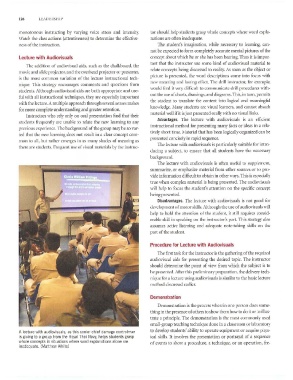
         A lecture with  audiovisuals,  as  this senior chief damage control man   to develop students' ability to operate equipment or acquire phys-
         is giving to a group from  the Royal  Thai  Navy,  helps students grasp   ical skills.  It  involves  the presentation or portrayal of a sequence
         whole concepts  in  situations \-vhere  word explanations alone are   of events to show n procedure, a technique, or an operation, fre-
         inadequate.  (Matthew White)

