


Page 20 - NAVAL SCIENCE 3 TEXTBOOK
P. 20
SEA  POWE R AN D  NATI O NAL SECURITY   25

         most famous statement  is  that "war  is not  merci),  il  political  act,
         but  also  a real political  instrument, a continuation of policy car-
         ried out by other means." He continually asserted that military and
         political strategy Illllst go hand in hand.
            Clausewitz recognized the concept of "limited aims for limited
         warfare:' with the purpose of wearing down an opponent. In other
         words,  he saw  beyond  the battlefield  toward  the enforcement  of
         policy over all enemy. A later strategist, Hans DelbrUck, a German,
         further clarified Clausewitz's meaning. He showed that Clausewitz
         had defined  two  methods of conducting war:  annihilation of the
         enemy in decisive battle, and limited warfare or strategy of exhaus-
         tion. In  the  latter concept, the commander could  move  between
         battle and maneuver. The politicll object of war could be obtained
         by Illeans other than aU-out battle, such as by occupying territor)'.
         blockade, or destroying crops and COlllmerce.
            In  the  mid-nineteenth  century. technology  and  social  re\'o-
         lution  made  their  imprint on strategic  thinking. The  Industrial
         Revolution resulted  in  an  e\'cr-increasing list  of innovations that
         would facilitate wart:lI'e on i.l glob;:ll scale: propulsion s),stems, com-
         munications,  and  means to  project  power  o\'erseas.  Educational
         s)lstems  were  developed  to  train  professional officer corps,  and
         the social concepts of the day were used to shape the attitudes and
         nptitudes of people. Foremost of the philosophers of the time who
         added a whole new dimension to modern strategy was Karl J\·larx,
         the writer of Das Knpitnl. the basis of modern comlllunism.


         Schools of Strategy

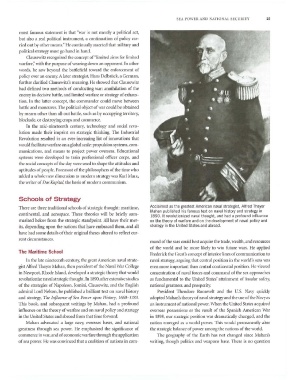
         There are three traditional schools of strategic thought:  maritime,   Acclaimed as the greatest American  naval strategist,  Alfred Thayer
                                                                Mahan  published his famous text on  naval  history and strategy in
         continental, and  aerospace. These  theories  will  be  briefly sum-
                                                                1890. It revolutionized  naval thought,  and  had a profound  influence
         marized below from  the strategic standpoint. AU  have their mer-  on the theory of warfare and  on  the development of  naval  policy and
         its, depending upon the nations that have embraced them, and all   strategy  in  the  United States and abroad.
         have had some details of their original theses altered to reflect cur-
         rent circumstances.
                                                                malld of the seas could best acquire the trade, wealth, and resources
                                                                of the world  and  be more  likely  to  win  future wars.  He  applied
         The  Maritime School
                                                                Frederick the Great's concept of interior lines of communication to
            In  the late ninetL'enth cenhlry, the great American naval strate-  naval stmtegy, arguing that central position in the world's se<Js was
         gist Alfred Thayer Mahan, then president of the Naval IVar College   even more important than cenlml continentlll position. He \'iewed
         in Newport, Rhode Island, de\'eloped a str<ltegic theory that would   concentration of naval forces and command of the sea approaches
         revolutionize na\'al strategic thought. In 1890, atter extensive shldies   as  fundamental  to  the  United States' attainment  of insular safety,
         of the strategies of Napoleon, Jomini, Clauscwitz. and  the English   natiollal greatness, and prosperity.
         admiral Lord Nelson, he published a brilliant text on naval history   President  Theodore  Roosevelt  and  the  U.S.  No,1'  quickl)'
         and strategy,  The il/jllIel/ce of Sen  POlI'er IIpOI/  Histor)',  1660--1783.   adopted Mahan's thear)' of naval strategy and the usc of the Navy as
         This book,  and  subsequent  writings  by Mahan,  had  a  profound   an instrumcnt of national power. \,"hen the United States acquired
         influence on the theory of wart~lfe and on naval policy and strategy   overseas  possessions as  the  result  of the  Spanish-Amcricm  \Var
         in the United States and abroad from that time forward.   in  1898, our strategic position was dramatically changed, and the
            Mahan  advocated  a  large  navy.  overseas  bases,  and  national   nation  emerged  as a world power. This would  pernwnently alter
         greatness  through  sea  power.  He emphasized  the  significance  of   the stmtegic balance of power ilillong the nations of the world.
         commerce in w<Jr, and of economic wi.lrfare through the ilpplication   The geography of the  Eilrth  hilS not  changed  since  J\·lahan's
         of sea power. He was convinced that a coalition of nations in COI11 -  writing, though politics and  weilpons have.  There is  110  question

