


Page 161 - NAVAL SCIENCE 3 TEXTBOOK
P. 161
HASIC SEA;\IANS ilIP   167

          The)' also act as pelt)' oniccrs in  charge of gun crews and  dalll-  Line  is  made  from  either  natural  fibers  of  various  plants
          age control parties during general quarters. Under way, thc)' stalld   (manila, sisal, hemp. cotton. and  tlax), or synthetic  fibers sllch as
          boatswain's  mate of the  watch 011  the  bridge;  in  port  they  stand   11)'10 11  <lnd  Kevlar.  Of the naturcll  fibers,  /IIallila  is the one  most
          pelly officer of the  watch  on  the quarterdeck.  During replenish-  often used aboard  ship.  It  is strongest  ilild  most  expensive.  It is
          ment operations under wa)'.  boatswain's mates  have  most of the   made  from  the fibers of the abaca, or wild bananil  plant. raised
          key jobs at the transfer stations.                     chiefly  in the  Philippines (hence  the  name  milnila).  At one time
             The  boatswain's  mates  Oil  board  ship  have  much  influence   most all line lIsed on Navy ships was made Ii'OIll manila.
          011  their enlisted. They spend  most of their da)'  supervising sea-  'loday, however,  nylon  and  Kevlar  line  has  replaced  manila
          men.  They  have  the  responsibility of tmining, and working with,   for almost all  shipboard applications ill  the Navy except  high-line
          almost evelT new  person reporting on  board ship. ;"lal1),  people   transfer of personnel between ships at sea. Although nylon line is
          receive their first impressions of shipboard life in the deck division.   more expensive than manila, it is much stronger and lasts longer.
          The work  is often hard, and  the hours are long. Seamen arc often   For these reasons. nylon and Kevlar line is often cheaper in the long
          in  the open, exposed to the wcather. The  life  of a deck seaman is   run, even though its initial cost is greater than that of manila.
          demanding,  so  the  leadership  provided  by boatswain's  mates  is   Nylon does not rot or age as rapidly as natural fiber, so it keeps
          vel')' important.                                      its strength better throughout its life.  It is also less bulky,  requires
             In  larger ships.  the fi rst lieutenant  often  has ;l chief warrant   less stowage  space,  ~Ild is Illore  flexible, making  it  easier to  han-
          boatswain  as  an  assistant, in  addition  to  deck  division  officers.   dle.  Nylon  is  practically waterproof.  It  does not decay. and resists
          In  such cases. this officer is called the ship's uoatslI'aill. The senior   marine fungus growths. But nylon also stretches more thalll11anila
          boatswain's  mate will  serve as the leading boatswain's  m~te.  ~nd   under load. This  is why  it  is  not  used  for  transferring people or
          assists the ship's boatswain. First-class boatswain's mates normally   cargo  from  ship to ship b)' highline.  N)'lon  will  stretch abollt  50
          serve as division petty officers.                      percent before brenking,  but  when  it docs,  it  snaps  like  a rubber
                                                                 band. so it can be very dangerous under heavy strain.
                                                                   Although  wire  rope  has not  been  in  gel1eJ'<l1  use  for  some
          Marlinspike Seamanship                                 years. some ships still  lise it for situations where  extra strength  is

          The /liar/iI/spike is a tapered steel tool used lor separating strands   required, such as when storms or high winds are expected. Because
          of rope. It is the basic tool of the seaman, and hils become the sym-  such rope tends to  form  spurs or burrs on  the surtilCe over time,
          bolic "tool of the trade."                             people handling it should always wear heavy leather work gloves.
             Marlinspike seamanship concerns the use nnd carc or fiber line   They should take care  not  to  rub against it, since  the sharp burrs
          and wire rope used at sea. It includes  every kind of knotting and   Gill easily pierce light clothing and inllict severe cuts.
          splicing, as well as all  fanc)'work done with rope, twine, and cord.   Regardless of the  material fi'om  which  it  is made,  all  line  is
          It  takes knowledge and  skill  to  become proficient  in  mariinspike   formed  in  basically the sallie way. The natuml or synthetic fibers
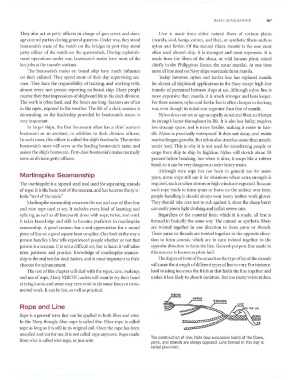
          seamanship. A good  seaman  h~s a renl  appreci~tion for  a sOllnd   are  twisted  together  in  one  direction  to  form  )'a1'l/s  or  thrends.
          piece of line or a good square knot or splice. One look at the way a   These yarns or threads are twisted together in  the opposite direc-
          person handles aline tells experienced people whether or not that   tion  to  form  stmnds. which  are  in  turn  twisted  together in  the
          person is n seaman. 1L  is not a difficult art, but to learn it well  takes   opposite direction to 101'111  the line. General-purpose line made in
          time,  pntience, and  practice.  Knowledge of marlinspike seaman-  this manner is known as plail/-Iaid.
          ship is the real test for deck Sailors. and is most important to their   The degree of twist of the strands or the type ofla), of the strands
          chances for advancement.                              will C<luse the strength of different types of linc to vary. For instance,
             The rest of this chapter will deal with the types, care, makeup,   hard twisting increases the friction that holds the line together and
         and  use of rope. [vfan), NjROTC cadets will  want to try their hand   makes it less likely to absorb moisture. fiut too many twists reduce
         at tying knots, and some may even wish to do some fancy or orna-
          mentnl work. It call be fUll, as weli as practical.


          Rope and Line

          Rope is a general term  that C<1n be applied  to both fiber and wire.
          In  the Nav)',  though, fiber rope is  called  lille.  Fiber rope  is  called
         rope as long as it is still in its original coil. Once the rope has been
          uncoiled and cut for use. it is not called rope anymore. Rope made
                                                                The construction of line.  Note how successive twists of the fibers,
         from wire is called wire rope, Or just lI'ire.
                                                                yarns, and  strands are  always opposed.  Line formed  in this way is
                                                                called  plain-laid.

