


Page 162 - NAVAL SCIENCE 3 TEXTBOOK
P. 162
168     NAVA L  SK ILLS

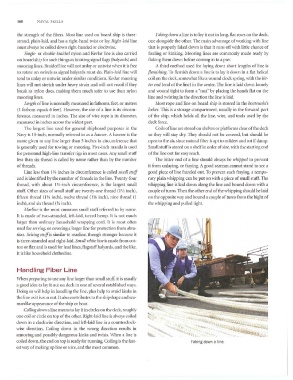
         the strength  of the fibers.  I\'lost tine  used  on board  ship  is three-  Fakillg d 0 1l'1I a line is to lay it out in long. flat rows on the deck,
         stmnd. plain-laid. and has a right-hand twist or la)'.  Right-laid line   one alongside the other. The main advantage of working with line
         must always be coiled down  right-handed or clockwise.   that is properly r..1ked down is that it runs off with  little chance of
            S;lIg/e- or double-braided nylon and  Kevlar line is also carried   fouling or kinking.  Mooring lines  are commonly mnde  ready b)'
         on board ship for such thing«1S hoisting signal nags (hal),ards) and   flaking them down before coming in to n pier.
         mooring lines. I3raided line will not ulllay or untwist when it is free   A third  method  used for laying down short lengths of line is
         to rotate on swivels as signal halyards mllst do.  Plain-laid line will   j7elllisltillg. '10 flemish down a line is to lil)' it down in a flat  helical
         tend to unlay or untwist under similar conditions. Kevlar mooring   coil on the deck, somewhat like a wound clock spring. with the bit-
         lines will  not stretch under heavy strain and will  not recoil if they   ter elld (end of the line) ill the center. The line is laid down loosely
         break as  nylon docs, making them  much safer  to  use than  nylon   and wound tight to  form a "mat" by placing the hands flat on the
         mooring lines.                                        line and twisting in the direction the line is laid.
            Length of line is normally l11e;:1sured in fathoms, feet, or meters   ~'I ost rope and line 011  bo,1rd ship is stowed in  the boatsl\'ain's
         (I fathom equals 6 feet).  Howe\,er, the size of a line is its circum-  locker. This is a storage compartment, usually in  the forward part
         ference, measured in  inches. The size of wire rope is its diameter,   of the ship.  which  holds all  the line.  wire. and  tools used b),  the
         measured in inches across the widest part.            deck force.
           The  largest line used  for  general shipboard  purposes  in  the   Coils of line are stored all shelves or platforms clear of the deck
         Navy is to-inch, normaUy referred  to as a hawser. A hawser is the   so the)' will  sta), dq·. The)' should  not  be cOl·ered. but  should  be
         name given to an)' line larger than 5 inches in  circumference that   opell to the air, since natural fiber is apt to mildew and rot if dnmp.
         is generally used for towing or mooring.  Five-inch manila  is used   Small stuff is stored 0 11  a shelf in order of size, with the starting end
         for personnel high-line transfer rigs in  most cases. An)' small stuff   of the line out for eas), reach.
         less  than sLx-thread  is called  by name  rather than  by the number   The bitter end of a line should alwa),s  be  whipped to  prevent
        of threads.                                            it from  unlaying, or fraying. A good seaman cannot stand to see a
            Line less  than  I Y4  inches in  circumference is called sl11al/ stllff   good piece of line frazzled out. To prevent Stich fraying. a tempo-
        and is identified b)' the number of threads in the line. Twenty-four   rary plain whipping can be put on with a piece of small s tllft~ The
         thread, with  about  1 ¥.I-inch  circumference,  is  the  largest  smail   whipping line is laid down along the line and bound down with a
        stuff.  Other sizes of small stuff arc twenty-one thread  (1 Vl inch),   couple of turns. Then the other end of the whipping should be laid
         fifteen  thread (1'4  inch).  twelve  thread  (I Ys  inch).  nine thread  (I   on the opposite way and bound a couple of turns from the bight of
         inch). and six thread (J<i  inch).                    the whipping and pulled tight.
           JV/ar/ille is the 1110st C01111110 11  small stulf referred to b)' IHlme.
         It is  made of two-stranded, left-laid, tarred hemp.  It  is not mllch
        larger  than ordinary  household  wrapping cord.  It is most often
        lIsed for serJlillg. or covering a larger line for protection from abra-
        sion. Seiz;Ilg stl~tJis similar to  marline, though stronger because it
        is three-stranded and right-laid. Sl11allwhite /ille is made ti'om cot-
        ton or flax and is used for lead lines. flagstaffhal),ards. and the like.
         It is like household clothesline.


        Handling Fiber Line
        \Vhen preparing to use any line larger than smail stutl  it is usually
        a good idea to lay it out on deck in one of several established ways.
        Doing so will  help in handling the line. plus help to avoid kinks in
        the line as it is run oULlt also contributes to the shipshape and sea-
        manlike appearance of the ship or boat.
           Coili"g d01V1I :.1  line means to lay it in circles on the deck, roughly
        one coil or circle on top of the other. Right -laid line is always coiled
        down in  a clockwise direction, ilnd left-laid line in  <1  counterclock-
        wise  direction. Coiling  down  in  the  wrong  direction  results  in
        annoying and possibly dangerous kinks and  twists. \Vhen a line is
        coiled down. the end on top is ready for running. Coiling is the t:lst-  Faking down a line.
        est way of making up line or wire, and the most common.

