


Page 163 - NAVAL SCIENCE 3 TEXTBOOK
P. 163
BAS IC SEAMAN SHIP    169

                                                                   Wet  fiber  lines  should be dried  thorough I)' before stowing. If
                                                                this canllot be done, the line should be faked out on gmtings under
                                                                cover so it can dryas quickly as possible. All fiber lines shrink when
                                                                wet and stretch again when dried out. for this reason, wet lines in
                                                                use should be slackened when the weather becomes damp or lines
                                                                become wet with  rain.
                                                                   A line with a kink should ne\'er be placed under strnin. A heavy
                                                                strain on a kinked or twisted line will  cause permnllent distortion
                                                                or damnge,  seriously  wenkening  the  line.  \Vhen n kink  has been
                                                                forced into each strand, it is impossible to work it out.
                                                                   Line will weaken with use ilnd exposure. Nylon line will grad-
                                                                unlly change its color from  yellowish-white to gra}'. It is necessary
                                                                to  inspect  the  inner  pilrt  of il  line  to  determine  its  real condi-
              Flemishing down a line. The bitter end  is in the center.
                                                                tioIl, though. The strands are  unlnid either b)' hnnd or with  a fid.
                                                                a pointed, round, tapered  wooden tool designed for splicing fiber
            A permanent whipping is put all with  a palm  and  needle. A
                                                                lines. If weakened, the  yarns will  show  bristles nnd  n decrease  in
         pnllll is a tough piece of leather th,lt fits into the palm of the sea-
                                                                diameter.  Lines  in  such  wenkened  conditioIl  should  not  be  llsed
         man's  hand,  serving  somewhat  the  same  purpose  as  a  thimble.
                                                                and certainly never for supporting people aloft or over the side.
         This is rarely done to line or rope smalier than  I J/.i  inches, but nor-
         mally is done with larger lines.
            The bitter end of a Ilrlon line is usually secured by taping the
         end of each strand and then taping all  strands together and fusing
         the end of the line with a hot iron or torch. The heat will melt and
         fuse the line together.
            t\ good  rule to  remember with  an)' line is that  nil  loose ends
         mllst be whipped, Cllt, or tucked  in order for  the ship to  maintain
                                                                                          >00\.0 T><f  lU~><O II' _11 M
         a smart, shipshape appeanlIlce. Attention to such detnil  is  impor-             "10(,(. U<O  '_I Iff(*(
                                                                                          ,OU'Vl.l 0111  T>«  110
         tant; the ship that takes care of such details usually performs well
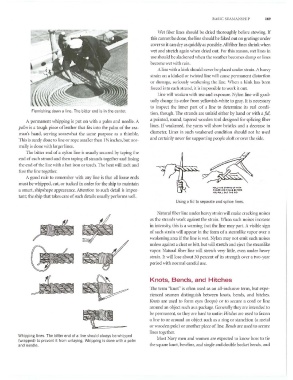
                                                                           Using a tid to separate and splice lines.
                                                                   Natural fiber lille under heavy strnin will make crnckillg noises
                                                                as the strands work against the strain. \Vhen such noises  increase
                                                                in intensity,  this is a warning thnt the line may pnrt. A visible sign
                                                                of slich strain will appenr in  the form  of a steamlike vapor over a
                                                                wenkening area if the line is wet.  Nylon may not emit such noises
                                                                unless agitinst il cleat or bitt, but will stretch ::md eject the steamlike
                                                                vnpor.  Natural fiber line will  stretch  very little, cven under heavy
                                                                strnin. It \\'ill iose about 30 percent of its strength  over n two-year
                                                                period with normal careful lise.


                                                                Knots, Bends, and Hitches

                                                                The term "knot" is  often used  ns an all-inclusive  term, but expe-
                                                                rienced  seamen  distinguish  between  knots,  bends,  nnd  hitches.
                                                                KIIDls  nre  used to  form  eyes  (loops)  or  to secure n cord  or  line
                                                                nroulld nn objeci stich ns n pnckage. Generally they nre intended to
                                                                be permanenl, so they nre hard to untie: Hitches are used to I~lsten
                                                                n line to or around an object such as a rillg or stanchion (il metill
                                                                or wooden pole) or another piece of line. Bends arc used 10 secure
                                                                lines together.
         Whipping lines.  The bitter end of a line should  always be whipped
                                                                   l\'losl Navy Illen <lnd women are expected  to  know how to tie
         (wrapped) to prevent it from  unlaying. Whipping is done with a palm
         and  needle.                                           the square knot, bowline, Hnd single <lnd double becket bends, and

