


Page 174 - NAVAL SCIENCE 3 TEXTBOOK
P. 174
180      NAVAl.  SKILLS

         a large pelican hook that is shackled to the towing pad and made   Rigging.  The  term  riggillg  is  used  for  all  wires.  ropes,  and
         fast to a towing hawser. The hawser is attached to one of the towed   chains supporting masts or kingposts  (vertical  poles), and oper-
         ship's anchor chains.  which  is  let out through the bull-Ilose  and   ating booms and cargo  hooks.  Stmufillg riggillg includes all  lines
         veered to about 20 t:lthoms.                           that support masts  or kingposts but do not move,  sllch as  stays
            The  length  of the  towline-hawser  and  chain-is adjusted   and shrouds.  RWlllillg rigging includes  all  movable lines  that run
         to  hang in  a deep  catenary.  This catenary helps to  relieve surges   through blocks, such as lifts, whips, and vangs, described below.
         on the line caused by movements of the two ships. Proper towing   Booms. A bool/l is a long pole built of steel. The lower end is fit-
         technique requires that the towline be of such scope that the two   ted  with a gooseneck, which supports the boom in a boom  step
         craft are "in step." Both must reach the crest of a wave at the same   bracket. The frec end is raised or lowered and held in position b)' a
         time. or the  towline will  be whipped  out of the  water under ter-  cable called a toppillg lift. Booms range in capacity from 5 to 75 tons.
         rific strain. Once properly rigged, the towing vesse( must barely get   Booms are moved into position, and cargo is moved into and
         under wa)' as the towed vessel begins to move. A sharp start or jerk   out of holds by running rigging. 'lopping lifts mo"e the ITee end of
         ma)' part the towing hawser. Speed is gradually increased to about   the boom "erticall), and hold  it at the proper height. Inboard and
         5 or 6 knots for the duration of the tow.              outboard guys. or mllgs, move the boom horizontally or hold it ill
                                                                working position owr a hatch or dock. The cargo hook is raised or
                                                                lowered byemgo whips running from winches.
         Cargo Handling

         Cargo  is loaded  or oftloaded  b)'  ship's  gear, or  dockside  winches
                                                                Underway Replenishment
         and floating cmnes when  in  port. At sea  the ship's gear is llsed  for
         undem'a)' replenishment (Un Rep) either b)' another ship (ConRep),   In  addition  to  anchoring  and  mooring, one  of the  more  fre-
         or b)' helicopters (VertRep), in which case ,'er), little ship's gear will   quent  deck seamanship evolutions done by the  deck personnel
         be used. Amphibious and mobile logistic ships have hea'T-lift cargo   of naval ships is underway replenishment (UnRep) while along-
         systems.  In sllch ships, deck seamanship  is mainly concerned with   side another ship  (ConRep).  Such operations may  involve  the
         heavy-cargo handling. Sailors in  these ships need to know about all   transfer  of fuel,  cargo,  ordnance,  and  sometimes  personnel  by
         the parts of cargo gear and the variolls "rigs" for handling cargo.   high/hie tmns/er. Normally the ship receiving the transfer maneu-
                                                                vers alongside the suppl)'ing ship, Once alongside. light  heaving


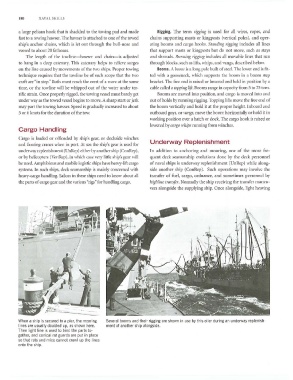
         When  a ship is secured  to a pier, the mooring   Several booms and their rigging are shown  in  use  by this oiler during an  under\'Jay replenish-
         lines are  usually doubled up,  as  shown  here.   ment of another ship alongside,
         Then  light line is used to bind  the parts to-
         gether, and conical  rat guards are  put  in  place
         so that rats and  mice cannot crawl up the  lines
         onto the ship.

