


Page 186 - NAVAL SCIENCE 3 TEXTBOOK
P. 186
Introduction to  Navigation


         Navigation  is  a fundamental  nautical science. Like seamanship, a   perpendicular to its axis. The word "equator" implies "equal parts."
         knowledge of navigation is basic to operating on water. Navigation   It lies exactl), halliva), between the north and south poles. The top
         enables the mariner to locate his  or her position  und  to get from   half of the globe is called the Northel'll Helllisphere (northern "half-
         one place to another.                                  sphere"), and the lower half is the SOl/them Hemisphere.


         T he Terrestrial S phere                               Great C ircles
         To  discliss  navigation  and  nautical  charts,  we  mllst  first  under-  Meridians  and  the  equator  are  called  great  circles  because  they
         stand  the Earth.  In  navigation, the Earth  is called the globe or ter-  each divide the globe into 1'.\'0 halves. Any circle drm\'n around the
         restrial  sphere  (this latter  term  comes  from  the  Latin  word  term,   Earth so as to divide the world into equal parts, or hemispheres, is
         which means "earth"). Our planet is spherical. Actually, our Earth   called a great circle.
         is a little flattened  at the poles instead of being perfectly spherical.   The concept of the grcat circle is vcry important, so it should
         But this can be disregarded in Illost cases in navigation.   be clearly understood. A great  circle  is  any  circlc  formed  on  the
            There are se\'eral  reference points for  locating objects  011  the   Earth's  surface  by  passing a plane  through  its  center,  dividing  it
         Earth.  The  lIorth  pole  and  sOlllh  pole  are  located  at  the  ends  of   into 1'.\'0 halves,
         the axis on which  the Earth  rotates. The imaginary lines running   Look at the globe. You will note that all meridians are great cir-
         through the poles and around the Earth arc c.lUcd lIIeririialls. The)'   cles, Of all the lines going around the globe from east to west, how-
         divide the surface of the Earth into sections much as yotl might cut   ever, only  the equator  is  a great circle.  The other lines  are  called
         an orange for eas), peeling.                           pnmllels, since they go around the globe parallel to, and north and
            The imaginary line that fUllS arollnd  the center of the  Earth,   sOllth of, the equator. They <.\fe all smaller circles than that made by
         cutting  every  meridian  in  half and  dividing  the  Earth  into  top   the equator. Of the parallels, onl)' the equator cuts  the globe into
         and bottom  halves, is  called  the equator.  It  is  formed  by  passing   1'.\'0 hemispheres.
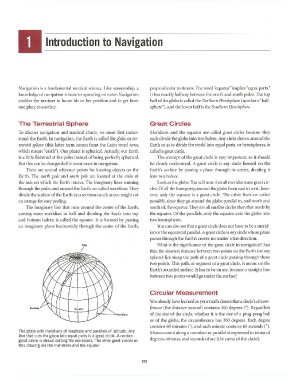
         an  imaginary plane horizontally through  the center of the Earth,   You can also see that a great circle does not have to be a merid-
                                                                ian or the equatorial parallel. A great circle is (/1/)' circle whose plane
                                                                passes through the Earth's center, no matter what direction,
                                   Pol'                            \,Vhat  is  the significance of the great circle in  navigation? Just
                                   I                            this: the shortest distance beh\'een two points on the Earth (or an)'
                                                                sphere) lies along the path of a great circle passing through those
                                                                two points, This path, or segment of <.1  great circle, is an arc Oil  the
                                                                Earth's rounded surface. It has to be an are, because a straight line
                                                                beh\'een 1'.\'0 points would go under the surface!


                                                                C ircular Measurement
                                                                You already have learned in your math classes that a circle's circfllI/-
                                                               jere/Ice (the distance around) contains 360 degrees (0), Regardless
                                                                of the size of the circle, whether  it  is  the size of a ping-pong ball
                                                                01'  of the globe,  the circumference  has  360  degrees,  Each  degree
                                                                contains 60 minutes ('), and each minute contains 60 seconds (It),
         The globe with  meridians of longitude and  parallels of latitude. Any   J'v1cilsurcment along a meridiem  01' parallel is expressed in terms of
         line that cuts the globe into equal  parts is a great circle.  A random
         great circle is shown cutting the  meridians. The  other great circles in   degrees, minutes, and seconds of arc (the CUJye of the circle),
         this drawing are the  meridians and the equator.


                                                            192

