


Page 203 - NAVAL SCIENCE 3 TEXTBOOK
P. 203
~IAR I NE NAVIGATI ON   209


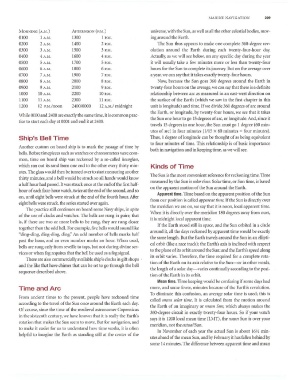
         MORNING (A.M.)        AFTERNOON (P.M,)                 universe, with the Sun, as well ilS a\l the other celestial bodies, mov-
         0100     1 A.M.       1300         I P,M,              ing around the Earth.
         0200     2  A,;\1.    1400         2 p,M.                 The Sun  thus appears to  make one complete 360-degree rev-
         0300     3 A.;\1.     1500         3 1'.;\1.           olution  around  the  Earth  during  each  twenty-four-hour  day.
         0400     4  A,M.      1600         4  P.M.             Actually, as we will see below, on any specific day during the year
         0500     SA,M,        1700         5 P.;\1.            it  will  usually take a few  minutes  more or less  than  twenty-four
         0600     6 A,;\1.     1800         6  P,;\1.           hours for the Sun to complete its journey. But on the average over
         0700     7  A,~1.     1900         7  P,~1.            a year, we can say that it takes exactly twenty-four hours.
         0800     8 A,~1.      2000         8 P,M,                 Now,  because  the Sun  goes 360 degrees around the Earth  in
         0900     9 A,~l.      2100         9 P.M.              twenty-four hours on the average, we can say that there is a definite
         1000    lOA.M.        2200        10  P.M.             relationship between arc as measured in an east-west direction on
         1100    11  A.~I.     2300        II P.M.              the surface of the Earth  (which we saw in  the first chapter in  this
         1200    12  p.~I .lnoon   240010000   12 ,ul./ midnight   unit is longitude) and time. If we divide 360 degrees of arc around
                                                                the Earth, or longitude. by twenty-four hours. we see that it takes
         \·"hile 0000 and 2400 are exactly the same time. it is common prac-
                                                                the SUI1 one hour to go 15 degrees of arc, or longitude. And, since it
         tice to start each day at 0001  and end it at 2400.
                                                                travels IS degrees in one hour, the Sun must go  1 degree (60 min-
                                                                utes of arc)  in  four minutes (IllS x 60  minutes = four minutes).
         Ship's Bell T ime                                      Thus,  I degree of longitude can be thought of as being equivalent
                                                                to four  minutes of time.  This relationship  is of basic  importance
         Another custom on board  ship  is to  mark  the passage of time by
                                                                both in navigation and in keeping time, as we will see.
         bells. Before timepieces such as watches or chronometers were com-
         mon, time  on  board  ship  was  reckoned  by  a so-called hOllrglass,
         which ran out its sand from one end to the other every thirty min-  K inds of T ime
         utes. The glass would then be turned over to start measuring another
                                                                The Sun is the most convenient reference for reckoning time. Time
         thirty minutes, and a bell  would be struck so all hands would know
                                                                measured by the Sun is solar tillle. Solar time, or SUl1time, is based
         a half hour had passed. It was struck once at the end of the first half-
                                                                on the apparent motion of the Sun around the Earth.
         hour of each four-hour watch, twice at the end of the second, and so
                                                                   Apparent time. Time based on the apparent position of the Sun
         on, until eight beUs were struck at the end of the fourth hour. After
                                                                from our position is called nppnrellt time. If the Sun is directly over
         eight bells were struck, the series started over again.
                                                                the meridian we are on, we say that it is noon, local apparent time.
            The practice still continues on board some Navy ships, in spite
                                                                \·"hen it is directly O\'er the meridian  180 degrees away from ours,
         of the  use of clocks and watches. The bells are  rung in  pairs; that
                                                                it is midnight local apparent time.
         is,  if there are two  or more bells  to be  rung, the)' are  rung closer
                                                                   If the Earth stood still  ill space, and the Sun orbited in a circle
         together than the odd bell. For example, five bells would sound like
                                                                around it, all the days reckoned by apparent time would be exactly
         "ding-ding, ding-ding, ding." An  odd number of bells marks half
                                                                the same length. But the Earth travels around the Sun in an ellipti-
         past  the  hour, and an  even  number marks an hour. \·"hen  used,
                                                                cal orbit (like a race track); the Earth's axis is inclined with respect
         bells are rung only from reveille to taps, but not during divine ser-
                                                                to the plane of its orbit around the Sun; and the Earth's speed along
         vices or when fog requires that the bell be used as a fog signal.
                                                                its orbit varies.  Therefore, the time required  for a complete  rota-
            There are also commercially available ship's clocks ill gift shops
                                                                tion of the Earth on its axis relative to the Sun- or in other words,
         and the like that have chimes that can be set to go through the bell
                                                                the length of a solar day- varies continually according to the posi~
         sequence described above.
                                                                tion of the Earth ill its orbit.
                                                                   Mean time, Time keeping would be connlsing if some days had
         Time and Arc                                           more, and some fewer, minutes because of the Earth's revolution.
                                                                To  eliminate this confusion, an average solar time is used; this is
         From  ancient  times to  the  present,  people  have  reckoned  time
                                                                called  mea1l  solar  tillie,  It is calculated  from  the  Illotion around
         according to the travel of the SUll  once around the Earth each day,
                                                                the Earth  of an  imaginaq' or men/l  51111,  which always  makes the
         Of course, since the time of the medieval astronomer Copernicus
                                                                360~degree circuit in  exactly twenty-four  hours. So  if your wi1tch
         in the sLxteenth century, we have known that it is reaUy the Earth's
                                                                says it is 1200 local  mean time (UvIT), the lIIeml SUIl  is over your
         rotation that makes the Sun seem to move. But for navigation, and
                                                                meridian, not the actual Sun.
         to  make it easier for  us to understand how time works, it  is often
                                                                   In  November of each  year the achIaI  Sun is  about  161h  min-
         helpful  to  imagine the Earth  as standing still  at  the center of the
                                                                utes ahead of the meal1 SUI1, and by Februar)' it has 1"lIen behind b),
                                                                some 14 minutes. The difference between apparent time and mean

