


Page 239 - NAVAL SCIENCE 3 TEXTBOOK
P. 239
NAVAL  WEAPONS  AND  AIRCRAFT   245


        region, and in attacks <lgainst al Q<leda terrorists and the Taliban in   ing aircraft. Once the missile closes in on the target, its active radar
        Operation Enduring freedom in Afghanistan.             guides it to intercept. This enables the aircraft pilot to aim and f1re
           The standoffland attack missile (SLAM) was developed in the   several missiles ilt once at  multiple targets, and then perform eva-
        icltc  1980s to give the Navy a surgical strike capability against high-  sive  maneuvers while the missiles guide themselves to  the targets.
        valuc land targets and ships. Originally used  in  Iraq in  Operation   The missile has a high-explosive Ii'agmentation w<.lrhead.
        Desert  Storm  in  1991,  it  has  been  continuously  improved  and
        upgraded since its introduction. The SLAM can be launched from
                                                               Navy Surface-to-A ir Missiles
        a variety of Navy fighter, attack, and patrol aircraft. It has a range in
        excess of 150 nautical miles.                          During the  1960s and  1970s, the second line of Heet defense was
                                                               centered on the "3 Ts," the N"'T'S first surt'lCe-to-air  (SAM/RIM)
                                                               guided missiles: Terrier, Tartar, and Talos.  The RIM-2 Terrier was
        Navy A ir-to-A ir  Missiles
                                                               the Navy's  first operational SAM  missile. \Veighing 3,000 pounds,
        The ti'ont line of defense for a naval task force is its combat air patrols   it was a solid-fuel missile with a range exceeding 10 miles at a speed
        (CAP), which range t:lr out ti"Olll  the Heet to meet incoming enemy   of Mach 2. Tartar was similar to Terrier but weighed half as much.
        air threats with highlycapable air intercept missiles (AIM).   The Talos  missile  was  for  many years the Navy's  largest ship-
           The AIM-9 series Sidcwindcr missile  is  carried by both Navy   board  surface-to-air  missile.  It  was  designed  for  launching from
        and Air Force fighter and llttack aircraft and is designed for  use in   cruisers,  for  long-range  air  defense.  It  weighed  7,000  pounds
        close-range, dogfight-type air engagements. The missile is illl infi'a-  ilnd  was  propelled  by  a  ramjet  engine.  Its  longest-range  version
        red homing heat-seeker <lir-to-air  missile.  It varies in weight from   exceeded 100 miles, with a ceiling of 80,000 feet.  It Wi.1S  phased out
        160 to 210 pounds depending on the version, has a speed of 1\·lach   in the late  1970s.
        2.5, a range of about 2 miles, and is  capable of operating against   Numerous improvements were made in  the Terrier and Tart<.ll'
        high-performance aircraft at altitudes ti'OIll sea level to over 50,000   missiles over the years, culminating in  the Standard missile series,
        feet.  The improved fuse, warhead, imd maneuverability of the lat-  featuring both medium-range (MR) and extended-range (ER) wr-
        est model  provides U.S.  pilots with the best  possible aclVi.ll1tage  in   sions.  Presentl), the Standard-2  (SM-2)  is  the Nav)"s  primal'), sur-
        close combat.                                          face-to-air air defense weapon.  It  is  an  integral part of the AEGIS
           The  AIM-120  advanced  medium-range  air-to-air  missile   \\'eapon  system  (A\VS)  aboard  1'icOildcroga-ciass  cruisers  ilnd
        (Ai\·lRAAM)  is  the latest in  the Navy inventory. It was developed   Arlcigh Bllrkc-class destroyers, and is launched from the J\·IK 41  ver-
        jointl), by the United States and several  NATO  nations.  It is a tol-  tical launch s),stem (VLS). The Standard-2 /vIR,  IS'h reet long and
        low-on to an older  missile series called  the Sparrow.  It has active   weighing some 1,500 pOllnds, has a range in excess of 90 miles and
        radar  guidance  and  an  on-board  computer  system  that  makes   a ceiling greater than 80,000 feet. The Standard-2 ER, 21 ,/, feet long
        the missile independent of the f1re-control  s)'stem of the l<1unch-  and weighing some 3,200 pOllnds, has a range exceeding 200 miles


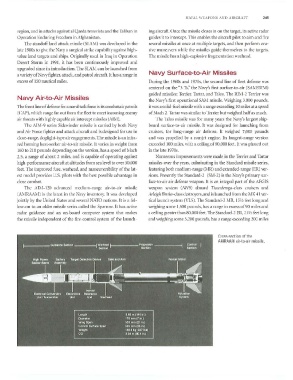
                                                                                            Cross-section of the
                                                                                            AMRAAM  air-to-air missile.

