


Page 237 - NAVAL SCIENCE 3 TEXTBOOK
P. 237
N,WAL  WEAPONS  AND  ,\IRCRAFT   243


        because  of arms control  agreements  negotiated  with  the  Soviet
        Union  in  the  late  1970s.  The  Navy  has  developed  an  Am,,1  ver-
        sion of the ship-launched Standard  sl1l'l~lCe-to-,lir missile, to  pro-
        tect against future potential ballistic missile threats to the !leet and
        to  the  United  States  m<.linland.  It may also  be  used  in  the  future
        to provide protection to NATO countries imd other allies either in
        addition to or in lieu of ground-based Am,,1 systems.
           Although  not originally designed  to be  an  Am,,1 missile,  the
        Army's  mobile  Patriot  missile  system  was  extensively  used  to
        knock  down  incoming  Iraqi  Scud  missile  warheads  fired  against
        Israeli and Saudi Arabian  targets during Operation  Desert Storm
        in  1991. It has been continuously improved since.
           IVlodern military aircraft fly so high and last that conventional
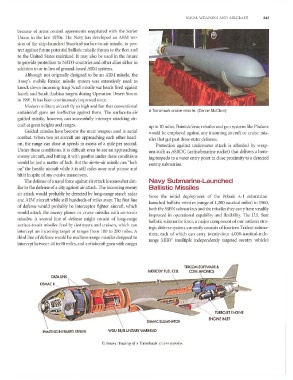
                                                               A Tomahawk cruise  missile. (Daniel  McClain)
        antiaircraft guns  are  inefiecti\'e  against  them.  The  surface-to-air
        guided  missile, however,  can  successfully  intercept attacking air-
        craft at great heights and ranges.                     Up to 10 miles. Point defense missiles and gun systems like Phalanx
           Guided missiles have become the main weapon used  in  aerial
                                                               would be employed against any  incoming aircraft or cruise mis-
        combat. \Vhen  two jet aircraft  are approaching eelCh  other head-
                                                               siles that got past these outer defenses.
        on, the  range can  close at speeds in  excess of a mile per second.
                                                                  Protection  against  undCI'Wi.lter  attack  is  afforded  by  weap-
        Under these conditions, it  is  difficult even  to see an  approaching
                                                               ons stich  as ASROC  (antisubmarinc rocket)  that  delivers a hOI11-
        enemy aircraft, and hitting it with gunfire under these conditions
                                                               ing torpedo to a water entry point in close proximity to a detected
        would be just a matter of luck. But the air-to-air missile can "lock
                                                               enem}' submarine.
        on" the hostile aircraft while it  is still  miles away and  pursue and
        hit it in spite of ilily evasive maneuvers.
           The defense ofa naval force against air attack is somewhat sim-  Navy Submarine-Launched
        ilar to the detense of a city against air attack. The incoming enemy   Ballistic Missiles
        air attack would probably be detected by long-range search  radar
                                                               Since  the  initial  deployment  of  the  Polaris  A-I  submarine-
        and AE\V aircraft while still hundreds of miles away. The first  line
                                                               launched ballistic missiles (range of 1,200 nautical miles)  in  1960,
        of defense  would  probably  be  interceptor  fighter  aircr,lft,  which
                                                               both the SS13N submarines and the missiles they carry have steadily
        would  attack  the enemy planes  or cruise  missiles  with  air-to-air
                                                               improved  in  operational  capabilit)'  and  tlexibility.  The  u.s.  fleet
        missiles.  A second  line  of defense  might  consist  of long-range
                                                               ballistic submarine force, a major component of our nation's stra-
        surface-to-air missiles fired  by destroyers and cruisers, which can
                                                               tegic detense system, currently consists of tourteen Trident subma-
        intercept an  incoming target at  ranges frolll  100  to  200  miles.  A
                                                               rines,  each  of which  can  carry twenty-tour  4,OOO-nautical-mile-
        third line of defense would be medium-range missiles designed to
                                                               range  MIRV  (multiple  independently  targeted  reentry  vehicle)
        intercept between 40 to 90 miles, and antiaircraft gUllS with  ranges


                                                                    IllUMINATOR

                   IMAGING INFRARED SEEKER    WDU· t 8/8 UNITARY WARHEAD

                                            Cutaway drawing of a Tomahawk cruise  missile.

