


Page 240 - NAVAL SCIENCE 3 TEXTBOOK
P. 240
246     NAVAL SKILLS


                                                                and a ceiling of 110,000 feet. The ne\\'est version, the Standard-3 ER,
                                                                about the same size and weight as the St"lIldard-2 ER, has a range of
                                                                over 270 miles, a ceili ng in excess of 150 miJcs, and was developed
                                                                for lise as an ABM. An  upgraded version of the Standard-2 ER, the
                                                                Si\-l-G  ERA..!"!  (extended  range active  missile),  is slated  to become
                                                                operational in 2010. it will  have improved capilbilities against agile
                                                                cruise missiles and over-the-horizoll targets.
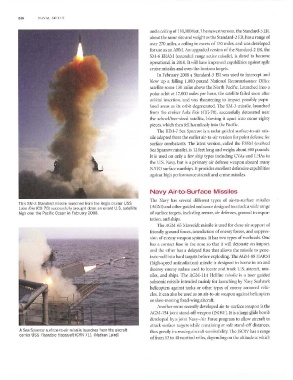
                                                                   In  February 2008 a Standard-3 ER  was  used to intercept and
                                                                blow  up  a  falling  l,OOO-pound  National  Recollnaissance  Office
                                                                satellite some 130  miles above the  North  Pacific.  Launched into a
                                                                pol<lr orbit at  17,000  miles per hour, the satellite t:liled soon after
                                                                orbital  insertion,  <lnd  was  threatening  to  impact  possibly  popu-
                                                                lated  areas  as  its  orbit degenerated.  The S1\'1-3  missile,  launched
                                                                from  the cruiser  Lake  Erie  (CG-70),  successfully  detonated  Ilear
                                                                the  school/bus- sized  satellite,  blowing  it  apart  into  some eighty
                                                                pieces, which then fell harmlessly into the Pacific.
                                                                   The RIM-7 Sea  Sparrow is  a  radar guided  surface-to-air mis-
                                                                sile adapted frolll the etlriier air-to-air version for point detense for
                                                                surface combatants.  The latest version, clUed  the [ SSM  (evolved
                                                                Sea Sparrow missile), is  12 teet long and weighs about 500 pounds.
                                                                It is used  on only a  few  ship  types including CVAs  and LHAs  in
                                                                the U.S.  Navy, but is  a primary air defense weapon aboard many
                                                                NATO surface warships. It provides excellent detensivc capabilities
                                                                against high perfo rmance aircraft and cruise missiles.


                                                                Navy Air-to-Surface Missiles

                                                                The  Navy  has  several  different  types  of air-to-surface  missiles
         This  SM~3 Standard missile launched  from  the Aegis cruiser USS
         Lake Erie (CG  70) successfully brought daVin  an errant U.S. satellite   (AG]\-1) ,md other guided ordnance designed to attack a wide range
         high over the  Pacific Ocean  in  February  2008.      of surface targets,  including armor, air defenses, ground transpor-
                                                                tation, and ships.
                                                                   The AGM-G5 Maverick missile is llsed for close air support of
                                                                friendly ground forces, interdiction of enemy forces, and suppres-
                                                                sion of enemy weapon systems. It has two types of warheads. One
                                                                has a COl1t .. lCt fLlse  in  the nose so  that  it  will  detonate on impact,
                                                                and  the other has a delayed  fuse  that allows  the  missile to  pene-
                                                                trate well into hard targets before exploding. The AGM-88 HARM
                                                                (high-speed antimdiation) missile is  designed to home in  all and
                                                                destroy enemy mdars  used  to  locate and  track  U.S.  ,lircraft,  mis-
                                                                siles,  and  ships. The AGM-114  Hellfire  missile is a laser  guided
                                                                subsonic missile intended mainly for launching by Navy Seahawk
                                                                helicopters  against tanks  or other  types of enemy armored vehi-
                                                                cles. It Ciln also be lIsed as an air-to-air weapon against helicopters
                                                                or slow-moving fL'\ed-wing aircraft.
                                                                   Another more recently developed air-to-surlilCe weapon is the
                                                                AGM- 154 joint stand-off weapon (JSOW). It is a large glide bomb
                                                                developed by a joint Navy- Air Force program to allow aircraft to
                                                                att,lCk surface targets while remaining at safe  stand-off distances,
         A Sea  Sparrow surface~to~ai r  missile launches from  the aircraft   thus greatly increasing aircraft survivability. The ISO\·V has a range
         carrier USS  Theodore  Roosevell (CVN  71). (Nathan  Laird)
                                                                of from  12 to 40 nautical miles, depending on the altitude at which

