


Page 246 - NAVAL SCIENCE 3 TEXTBOOK
P. 246
252      ~AVAL SKILLS


                            c     H


                                                         SEA     0  F
                                                          J  A  PAN
                             >                     SOUTH


                              Y  Ell  0
                                SEA


                                                                            NAil pO  ISLANDS
                                                                              ~ Japanese Defensive  Minelields
                                                                               g g g U.S.  01lensive Minefields
                                                                                '0


                                                                                                c
                                                               p    A     c          F          N
                            7                                     o       c      E      A
                                'V'

                                TAIWAN

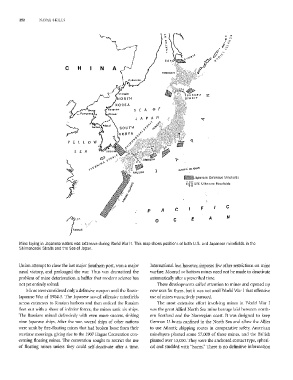
         Mine laying in Japanese waters was  extensive during World  War  II. This map shows positions of both  U.S. and Japanese  minefields in the
         Shimonoseki  Straits and the Sea of Japan.


         Union attempt to close the last major Southern port, won a major   International law, howevel; imposes tew other restrictions on mine
         naval  victory,  and prolonged the war.  Thus was  dramatized  the   'warfare, [vioored or bottom mines need not be made to deactivate
         problem of mine deterioration, a baffler that modern science has   automatically after a prescribed time.
         not yet entirely solved.                                  These developments called attention to mines and opened up
            Ivlines were considered only a defensive weapon until the Russo~   new uses for them, but it was not until \VorId \Var I that offensive
         Japanese  \,Var  of 1904-5. The Japanese sowed oftensive minefields   use of mines 'was actively pursued,
         across entrances to Russian  harbors and then  enticed the Russian   The  most  extensive  effort  involving  mines  in  \VorId  \Var  I
         fleet  out with a show of inferior forces;  the  mines sank six  ships.   was the great Allied North Sea  mine barrage laid between north-
         The Russians  rnined  defensively  with  even  more  success,  sinking   ern Scotland  and  the  Norwegian  coast.  It was  designed  to  keep
         nine  Japanese  ships. After  the  war,  several  ships  of other  nations   German U-boats confined in  the North Sea and allow the Allies
         were sunk by free-floating lnines that had broken loose from  their   to  use  Atlantic  shipping routes  in comparative safety, American
         wartime moorings, giving rise to the 1907 Hague Convention con-  minelayers  planted  some 57,000  of these  mines,  and the  British
         cerning floating  mines, The convention sought to  restrict  the  use   planted over 13,000. They were the anchored contact type, spheri-
         of floating  mines  unless  they  could  self-deactivate  after  a  time.   cal  and studded with "horns," There is  no definitive  information

