


Page 248 - NAVAL SCIENCE 3 TEXTBOOK
P. 248
254     NAVAL  SKIllS

                                                                   A (ombillatiOi/  mine, detonated by the simultaneous actuation
                                                                of two or all  three of the foregoing types of firing mechanisms,  is
                           SHIP'S  PRESSURE  SIGNATURE  A.      more eA-ective  beciluse  it is less susceptible  to  activation by fitlse
                  ,
               H :                                              targets ilnd harder to sweep. In order for stich a mine to detonate.
                                                                for example,  the  pressure influence of a ship mar have  to close a
                                                                switch at the same time as its magnetic field influences a coil. The
                                                                U.S.  arsenal  contains  mines  detonated  br  simultaneolls  actua-
                                                                tion  of all three  mechanisms.  Such  mines are  almost  impossible
                                                                to sweep.
                                                                   In  addition  to  the combination of various influence  mecha-
                                                                nisms,  "counters"  have  been  installed  in  some  mines.  These  are
                                                                designed to cause the mine to remain inert until the actuation pro-
                                                                cess  has  occurred  a preset number of times.  This  is  intended  to
                                                                gi\'C the enemy a false sense of security. by setting up the mines for
                                                                activ<1tion after minesweeping operations  have been "successfully
                                                                concluded" without mishap.
                                                                   Perhaps  the most unusual "mine" in the  Navy  arsenal is not
                                                                reall), a mine at all.  Called the CAPTOR  (encapsulated torpedo),
                                                                it  consists of an acoustic homing torpedo moored to  the bottom
                                                                with about 300 meters (  fcet) of cable. Primarily a US\-\' weapon,
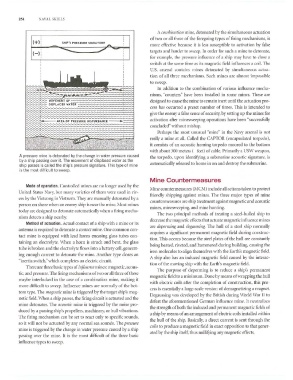
         A pressure mine is detonated by the change in water pressure caused   the torpedo,  upon  identi~ling a submarine acoustic  signature, is
         by a ship  passing over it. The movement of displaced water as the
         ship passes is called the ship's pressure signature.  This type of mine   automatically released to home in on and destroy the submarine.
         is the  most difficult to sweep.
                                                                Mine Countermeasures
            Mode of operation. Controlled mines are no longer lIsed by the
                                                                Mine countermeasures (MCM) include all actions t,lken to protect
         United States Navy,  but m.1I1Y  varieties of them were llsed  in  riv-
                                                                friendly shipping against  mines.  The  three  major types  of mine
         ers by the Vietcong in Vietnam. The)' arc manually detonated by a
                                                                countermeasures arc ship treatment against magnetic and acollstic
         person on shore when an enemy ship is ncar the mine.  ~'fost mines
                                                                mines, minesweeping, and mine hunting.
         today arc designed to detonate automatically when a firing mecha-
                                                                   The  two  principal  methods  of treating a steel-hulled  ship  to
         nism detects a ship nearby.
                                                                decrease the magnetic eA-ects that actuate magnetic influence mines
            Method of actuation. Actual contact of a ship with it mine or its
                                                                arc  riepel'lI/illg and  riegn/lssillg.  The hull  of it steel  ship  norm.llly
         antenna is required to detonate a COlllact mine. One common COIl-
                                                                acquires a significant permanent magnctic  field  during construc-
         tact  mine is equipped with  lead  horns encasing glass  tubes con-
                                                                tion. This occurs bCC<luse the steel plates of the hull are constantly
         taining an  electrolyte.  \Vhen a horn is struck and  bent, the glass
                                                                being heated, riveted, and hammered during building, causing the
         tube is broken and the electrolyte flows into a battery cell. generat-
                                                                iron  molecules to align themselves with  the Earth's magnetic field.
         ing enough current to  detonate the mine. Another type closes an
                                                                A ship also  has an  induced  magnetic field  caused  b)· the interac-
         "inertia switch," which completes an electric circllit.
                                                                tion of the moving ship with the E<trth's magnetic field.
            There al'e three basic types of il/fllle/ice mines: magnetic, ,lCOllS-
                                                                   The  purpose  of deperming  is  to  reduce  il  ship's pernlilllent
         tic. and pressure. The firing mechanisms of two or all three of these
                                                                magnetic field to a minimum. Done by mcans of wnipping the hull
         maybe  interlocked  ill  the case of it combination mine, making it
                                                                with electric  coils after the completion of construction, this  pro~
         more difficult  to sweep.  Influence  mines are  normally of the bot-
                                                                cess is essentially a large-scale version of demagnetizing a magnet.
         tom type. The //Iagnelic mine is triggered by the target ship's mag-
                                                                Degaussing was developed by the  British during \\'orld \"ar II  to
         netic field. \"hen a ship p<1sses, the firing circuit is actuated and the
                                                                defeat the <1forementioned German influence  mine. It neutralizes
         mine detonates.  The acol/stic mine is triggered  by the  noise  pro-
                                                                the strength of both the induced ,md permanent magnetic fields of
         duced by <l  passing ship's propellers, machulerr. or hull vibrations.
                                                                a ship by means of an arrangement of electric coils installed within
         The firi ng mechanism call  be set to react only to specific sounds,
                                                                the hull of the ship. Basically,  a direct current is sent through  the
         so it will  not be actuated by any normal sea sounds. The presslIre
                                                                coils to produce a magnetic field in exact opposition to that gener-
         mine is triggered by the change in water pressure callsed by a ship
                                                                ated by the ship itself, thus nulli~'ing nny magnetic eA-ects.
         p;lssing  OWl'  the mine,  It is the 1110st  difficult  of the three bilsic
         influence types to sweep.

