


Page 245 - NAVAL SCIENCE 3 TEXTBOOK
P. 245
Mine Warfare


        A mille as used ill naval  warfare is  a device containing a charge of   tact-firing devices.  An  unfortunate current caused  the kegs  to  go
        explosive in a watertight casing, flo::tting on, moored in, or planted   astray, and red tape in Congress prevented additional expenditures
        under a waterway for  the purpose of blowing lip  an enemy vessel   on the concept. In the early nineteenth century, Robert fulton, the
        that strikes it  or passes  close by  it.  J\'iinc warfare may be divided   inventor of the steamship, contributed to a slowly developing COI1-
        into detensivc and  offensive mining, and  mine countermeasures.   cept in  naval  w"lI't:1re  by demonstrating Ilwt a ship  could be sunk
        De/ellsil'e  Illillillg is  that which  is  done to  protect a  nation's  own   by an  underwater explosion.
        harbors and  shorelines. 0ffellsi!,c  lIIil/illg may  be  used  to  bottle   13y  the lime of the Civil  'Var, "torpedoes"  moored in  harbors
        up enemy harbors,  to  render their shipping routes  dangerous or   and rivers were considered a prime naval weapon, especially by the
        impossible to lise, and to make the enemy divert ships, equipment,   Confederates, who  used  them  to  defend against  the  much  larger
        and  personnel  to  mincswceping chores.  By  spreading millcfields   Union Navy.
        over as wide an area as possible, and by llsing several difterent types   Admiral  David  G.  Farragut's  attack  al  Mobile  !lay  in  1864
        of mines, the problem of rcmoving or s\\leepillg them is made for-  remains one of the more dram,,1tic episodes in the history of mine
        midable, and s,lie shipping routes become more and more difficult   war61re. The Confederates had planted some two hundred mines,
        to maintain. Offensive minefields also force enemy shipping to go   then called torpedoes, to force  Union ships into a channel covered
        through areas where it may be more readily attacked.   by shore b,ltteries, an early lise of a mining tactic that later became
           ,'-Ii/Ie CO/ll/terlllCl1sures constitute all  methods of countering an   standard.  \Vhen  the  Union  monitor  TCC/ll/Isch  hit  a  submerged
        enemy's  mines.  These  measures  include self-protcction for ships,   mine,  blew  up, and  sank,  the  Contederate batteries opened  fire.
        ,,1S  well as the sweeping of mines.                   Progress  into  the  harbor becilme  confused,  and  the  Union  force
                                                               seemed in danger of defeat. At this crucial point, however, Admiml
                                                               Farragut personally ordered his lorce ahead with the tamous quo-
        Evolution of Mine Warfare                              tation  "Damn  the  torpedoes- full  speed  ahead!"  taking  a  cal-
        During the  American  Revolution,  David  13ushnell  attempted  to   culated  risk  that  no ildditional  mines  would explode because of
        break the  British blockade of the Delaware  River  at  Philadelphia   saltwater deterioration. He was right, and the battle was won. \,Vith
        with floating kegs filled  with gunpowder and equipped with COI1-  a more reliable mine, the Confederates might have frustrated  the


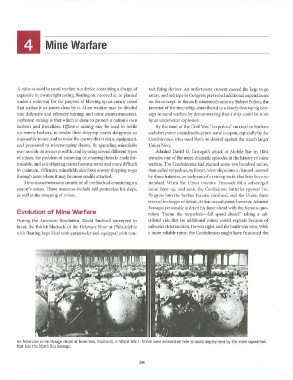
        An  American  mine storage depot at  Inverness,  Scotland,  in  World  War  I.  Mines were assembled  here  to await deployment by the mine squadrons
        that laid Ihe North Sea  barrage.


                                                           25\

