


Page 243 - NAVAL SCIENCE 3 TEXTBOOK
P. 243
NAVAL  WEAPONS  AND  AIRCRAFT   249


                                  TARGET  H-IGHTPATH

                                                        I
                                                       I            ,
                                                       I           I
                                                      I           I  I
                                                     I          ,  I
                                                    I
                                                               0"
                                                              ~
                                                              I           I
                                                 I
                                                I      ~/<
                                               I
                                              I
                                                         ., /

                                                    MISSILE  FLIGHT  PATH


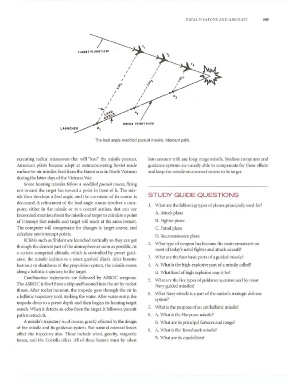
                                         The lead angle  modified pursuit missile  intercept path.


        execllting  radical  maneuvcrs  that  will  "lose"  the  missile  pursuer.   into account with any long-range missile. i,,[odem computers and
        American  pilots  became  adept  at  outmaneuvering  Soviet~made   guidance systems are  usually able to compensate for  these effects
        surface-to-air missiles fired from the Hanoi area in North Vietnam   and keep the missile on a correct course to its target.
        during the latter days of the Vietnam \Var.
           Some homing missiles follow a modified pursuit course,  flying
        not toward the target but toward a point in  front of it.  The mis-
        sile  thus  develops a lead angle,  and  the curvature of its  course  is   STUDY GUIDE QUESTIONS
        decreased. A refinement of the lead angle course involves a com-
                                                               I.  \'Vh'1t arc the following types of planes principally used for?
        puter,  either  in  the  missile  or at  a  control  station,  that  can  use
                                                                  tI. tlNack plane
        known intormation about the missile and target to calculate a point
        of intercept that missile and target will  reach at the same instant.   ll.  Fighter plane
        The computer will  compensate tor changes  in  target course, and   C.  Patrol plane
        calculate new intercept points.
                                                                  D. Reconnaissance plant?
           ICBI\·[s such as Trident are launched vertically so they can get
                                                               2.  \Vhat type of weapon has become the main armament on
        through the densest part of the atmosphere as soon as possible. At
                                                                  most of to day's Ililval  fighter and attack aircraft?
        a certain computed  i.1ititude,  which  is  controlled  by  prcset  gl1id~
                                                               3.  \Vhat are the four basic Pi.uts of a guided missile?
        ance,  the  missile  inclines  to  il  more gradual  climb. After booster
        burnout or shutdown of the propulsion s),stem, the missile coasts   4.  A.  \Vhat is the high-explosive part of a missile called?
        along a ballistic trajector), to the target.              ll.  What kind of high explosive may it be'
           Combillation  trajectories  are  followed  b)'  ASROC  weapons.
                                                               5.  \·Vhat are the five types of guidance systems lIsed by most
        The tlSROC is fired from a ship and boosted into the air b)' rocket
                                                                  NeW)' guided missiles?
        thrust. After rocket burnout, the torpedo goes through  the air in
                                                               6.  \Vhat Navy missile is a part of the nation's strategic defense
        a ballistic trajectory until striking the water. After water entry, the
                                                                  s),stem?
        torpedo dives to a preset depth and then begins its  homing target
                                                               7.  \,Vhat is the purpose of an .mtiballistic missile?
        search. \Vhen it detects an echo from the target, it follows a pursuit
        path to aNack it.                                      8.  A. \'Vhat is the Harpoon missile?
           A missile's trajectory is, of course, greatly affected by the design   B.  \,Vhat are its principal features ilnd range?
        of the missile and its guidance s),stem. But natural external forces
                                                               9.  A.  \Vhat is the Tomahawk missile?
        affect  the  trajectory  also.  These  include  wind,  gravity.  magnetic
                                                                  B.  \,Vhat are its capabilities?
        forces,  and the  Coriolis effect.  All  of these  factors  must be taken

