


Page 247 - NAVAL SCIENCE 3 TEXTBOOK
P. 247
NAVAL W EAPO N S AND  A I RCRAFT   253

        as  to  the success of this field  in sinking U-boats,  but  that  it  kept   Allied  ships were sunk  by mines during the  former connic!.  The
        them bottled up  to it considerable extent is certain. This dlllnaged   Viet Cong also  used improvised controlled  mines  in  the  rivers of
        German  submariners'  morale  and  simultaneollsly  boosted  the   SOllth VietIlam, which they would detonate from shore whenever
        morale of American  and  British  merchant  seamen  upon whom   a suitable  target came within  range.  Later, drifting mines caused
        wartime logistics depended.                            damnge to ships of several  nations in  the Persian Gulf during the
           Postwar statistics  re\'eal  that mines sank more ships than did   Iran-Iraq  \·Var in  the  1980s,  and  to sever.,1 U.S.  warships during
        torpedoes and gunfire combined during \\'orld \Var  I. The cost of   Operation Desert Storm in  1991.
        the North  Sea barrage was  determined  to  be equal to the cost of
        prosecuting the Will' for one day, so if it shortened the war by even
                                                               Mine C lassif ication
        that much, it was a good investment.
           Mine warli.ue of \Vorld  \Var II  featured offensive  mine-laying   ?\'lines are classified according to the method of planting (surface,
        by  both  subm<1rines and  <1ircmft.  Defensh'e  mining was  carried   aircraft, or submarine), the finnl planted position (moored, bottom,
        out mainly by con\'entional types of surti.lCe minelayers, and mine   or drifting), the mode of operation (controlled or automatic), and
        clearance was done primarily by surti.lCe  craft  equipped with spe-  the detonating or actuation mechanism (contact or influence).
        cial mincsweeping gear. COllntermeasures  included  novel devices   Method of planting. Mines can be planted b)' surface craft II'hen
        for protection and detection.                          secrec}'  is not of prime  importance.  High-speed  minelayers  can
           In  the opening  months of the  war,  Nazi submarines  and air-  carry many mines and ciln lay a large minefield in a relatively short
        cran sowed extensive minefields off the English and Scottish coasts.   time. Presently, however, the U.S. Navy has no minelayers in  COIll-
        A number of British ships were sunk by this mine barrage, which   missioned service.
        was especially heavy in the Thames estuary. Early in  the war, how-  Planting mines by submarine can be accomplished with great
        ever,  the Germans lost one of their secret  weapons,  an  influence   secrecy and  at  great distances from  home ports.  Once  the  mine-
        mine designed to  be triggered  b)1  the  magnetic  field of a passing   field  has been laid, however, friendly submarines cannot navigate
        steel-hulled ship. The mine, dropped by an airplane, overshot  its   in the area dming the armed life of the planted mines.
        mark and landed intact in a mud  bank. The British recovered  the   Aircraft-planted  mines C1I1 be carried and released like bombs
        mine and  shortly thereafter  produced  a successful  countermea-  or  torpedoes.  A parachute  is  attached  to  the  mine  to  slow  its
        sure, doubtlessly saving countless Allied ships.       descent; the  parachute separates  from  the mine case and sinks on
           Japanese  minefields  in  the  Pacific  during  the wnr  were  also   impact with  the water.  Aircraft  can carry mines  into enemy-held
        quite  extensi\'e.  They used  defensi\'C  minefields to  protect  their   areas, and  the  field  call  be  replenished, if necessary,  without dan-
        major bases and harbors. Their minefields west of the Nansei Shoto   ger from previousl), planted mines. There is little secrec)' in planting
        protected shipping in the East China Sea throughout the war. Until   aerial mines, though night-flying planes can be used to some extent.
        the last months of the war,  the Sea of Japan was effectively sealed   Aircraft can mine coastal and shallow waters that no other pliltfonn
        off from American submarine and surface ships by Japanese fields   could possibly mine. Blockading enem), shipping lanes and harbors
        in the stmits leading into that body of water from the Pacific. Both   can be very efiectiveiy accomplished b}' this type of mining.
        the Americans and the Japanese laid ofiensive  fields  to destroy or   Planted  position. Moored  mines have  buoyant  cases  contain-
        divert enemy shipping.                                 ing the explosive charge. The)' are kept at a predetermined depth
           During  the  Korean  and  Vietnam  wars,  Communist  forces   b)'  mooring cables attached  to  an  anchor. Because  the depth  of
        floated  mines dowll  rivers  into  harbors and  out  to  sea.  Se\'eral   the mines (;,111  be controlled by the length of their mooring cables,
                                                               the mines can be deployed in  shallow w"ter against small craft, or
                                                               in  deeper water against major stJJ'face ships and submarines. The
                                                               main  disadvantage  is that  they mily be cleared  with  comparative
                                                               ease by mechanical sweeping gear.
                                                                  For that reason, bottom  mines  were developed. They can  be
                                                               planted b)' an)' t)'pe of crali, and because the)' lie on the bottom,
                                                               they require cosll}, minesweeping gear to detect and rel110ve them,
                                                               both diflicult tasks. The), cannot be planted in lI'ater depths greater
                                                               than 30 fathoms, unless intended as antisubmarine weapons.
                                                                  Drifting  mines  are  IlOt  actually planted,  in  the  true  sense.
                                                               Often, however, it drifting mine is a moored mine that has broken
                                                               loose from its mooring cable and has become a hazard to all inter-
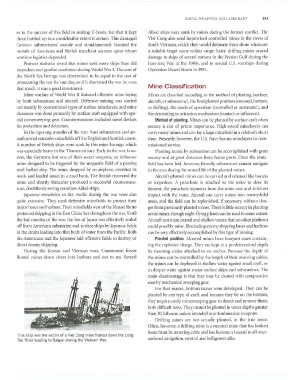
        This ship was the victim of a Viet Cong mine floated down the Long
        Tau  River leading to Saigon during the Vietnam War.   national navigation, neutml and belligerent alike.

