


Page 34 - NAVAL SCIENCE 3 TEXTBOOK
P. 34
SEA  POWER AND  NATIONAL SECURITY    39

          Revolutionary War

             Revolutionary war can take a number of different forms. Today,
          it often involves a conspiracy, culminating in a coup, that overturns
          an established government. Few people actually arc involved, and
          little is changed but the leadership.  In  times past, it  took the form
          seen in  the United States in  1776, and in  mllch of South America
          in  the early  nineteenth  century: a colonial war  tor independence
          from  a  mother COlilltl')',  with  opposing armed forces  engaged  ill
          traditional warfare, ending with a formal  treaty of peace and rec-
          ognition of sovereignty. The French  and Russian  Revolutions.  in
          contrOlst, were explosive upheavals of the masses. They turned out
          the old royalty and then consolidated the unexpected victories by
          means of infighting among various revolutionary groups until one
          dominant group emerged.
             Revolutionary  war  basically involves  efforts  to seize  political
          power by force  of arms, dcstro)1ing the existing government of a
         country and possibly its political, social,  and economic structures
          in  the process.  Such warfare today is carried on in  most cases by
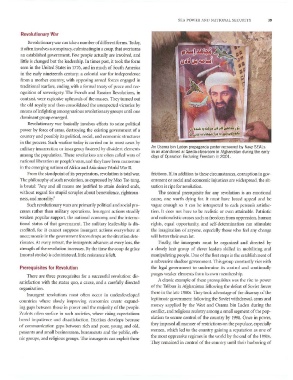
                                                                An  Osama  bin  Laden  propaganda  poster recovered  by Navy SEALs
          military insurrection or insurgency fostered by dissident clements
                                                                in  an  abandoned  al  Qaeda  classroom  in Afghanistan  during the early
         among the population. These revolutions are often called wars of   days of Operation Enduring Freedom  in 2001.
         nntionalliberation or people's wars, and thc}1  have been numerous
         in the emerging nations of Africa and Asia since \,Vorld \Var II.
             From the standpoint of its perpetrators, revolution is total war.   frictiolls. If, in addition to these circumstances, corruption in gov-
         The philosophy of such revolution, as expressed by Mao Tse-tung,   ernillent or social and economic injustices are widespread, the sit-
         is brutal: "Ail}'  and all  means are justified to  attain  desired  ends,   uation is  ripe for revolution.
         without  regard  for stupid scruples about benevolence, righteous-  The  second  prerequisite  for  all)'  revolution  is  an  eillotional
         ncss, and morality."                                   Cil USC,  one  worth  dyillg  for.  It  IllUSt  have  broad  appeal  and  be
            Such revolutionary wars are primarily political and social pro-  vague  enough  so  it  can  be  interpreted  to  each  person's satisfac-
         cesses  rather  than  milita!,)' operations.  Insurgent actions steadily   tion.  It does  not have  to be  realistic  or even  attainable.  Patriotic
         weaken popular support, the national ecollomy, and the  interna-  and nationalistic causes such as freedom from oppression, human
         tional  status  of that  government. The  military leadership  is dis-  rights,  equal  opportunity, and  self-determination  can  stimulate
         credited, for  it  cannot suppress  insurgent actions  everywhere  at   the illltlgination  of anyone, especially those  who  feel an)' change
         once; morale in the government forces drops as the situation dete-  will better their own lot.
         riorates. At every retreat, the insurgents advance; at  ever), loss, the   Finally,  the  insurgents  Illust  be  organized  and  directed  by
         strength of the revolution increases. By the time the COllP de grace   a  closely  knit  group  of  clever  leaders  skilled  in  mobilizing  and
         (morttll stroke) is administered, little resistance is left.   manipulating people. One of the first steps is  the establishment of
                                                                a subversive shadow government. This group constantly vies with
         Prerequisites for Revolution                           the  legal  government  to  undermine  its  control  and  continually
                                                                purges weaker elements ti'om its own membership.
            There are  three prerequisites  tor a successful  revolution:  dis-
                                                                   A classic example of these prerequisites was  the rise to power
         satisfaction  with  the status qllO,  a calise, and a carefully directed
                                                                of the Taliban  in AfghanistilI1  following the defeat of Soviet forces
         organization.
                                                                there in  the late 19805. They took advantage of the disarmy of the
            Insurgent  revolutions  Illost  often  occur  in  underdevelopcd
                                                                legitimate government following the Soviet withdrawal, arms and
         countries  where  slowly  improving  economies  create  expand-
                                                                money  supplied  by  the  \-Vest  and  Osama  bin  l.aden  during  the
         ing gaps between those  in  power and the Illtljority of the people.
                                                                conflict, and religious zealotry among a slllall segment of the pop-
         Zcalots  often  surface in  sllch  societies. where  rising expectations
                                                                ulation to secure control of the collntry by 1998. Once in  power,
         breed  impatience  and  dissatjsf~lCtion.  Friction  develops  because
                                                                they imposed all manner of restrictions on the populace, especially
         of communication gaps between  rich  ,lI1d  poor, young and old,
                                                                women, which  led to the collntry gaining a  reputation as  one of
         peasants and small businessmen, bureaucrats and the public, eth-
                                                                the most oppressive regimes in the world by the end of the 1990s.
         nic groups. and religious groups. The insurgents can exploit these
                                                                They remained  ill  control of the count!')' until their harboring of

