


Page 35 - NAVAL SCIENCE 3 TEXTBOOK
P. 35
40      NAVAL  KNOWLEDGE

                                                               STUDY GUIDE QUESTIONS

                                                               1.  \'Vhat main factors i.lffect a nation's national strategy?
                                                               2.  A.  \'Vhat are the three basic considerations in evaluating an
                                                                    e:>..1ernal  threat?
                                                                  13.  \Vhich is most difficult to ilSSCSS?
                                                               3.  A.  \Vhat are intelligence estimates intended to do?
                                                                  13.  \'Vhy are they so important?
                                                               4.  \'Vhat are the nine principles of war?
                                                               5.  \·Vhat is gencral war?
                                                               6.  \Vhat are the six potential actions that might cause a general
                                                                  Wi.lr to occur?
                                                               7.  \Vhat circumstances might cause entanglement of major
                                                                  powers in a war that could escalate to general war?
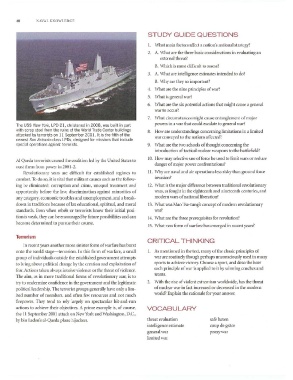
        The USS  New York,  LPD~2 1, christened  in  2008, \'las  built  in  part
        with  scrap steel  from  the  ruins of the World  Trade Center buildings   8.  How are understandings concerning limitations in a limited
        attacked by terrorists on  II September 2001. tt  is the fifth of the   war conveyed to the nations afiected?
        newest  San Antonio-class LPDs,  designed  for missions that include
        specia l operations aga inst terrorists.               9.  \Vhat arc the two schools of thought concerning the
                                                                  introduction of tactical nuclear weapons to the battlefield?
                                                               10.  How may selective use of force be used to limit wars or reduce
        AI Qaeda terrorists caused the coalition led by the United States to
                                                                  danger of major power confrontations?
        oust them from  power in 200 1-2.
           Revolutionar}'  w.1['s  are  difficult  for  established  regimes  to   11.  \·Vhyare naval and air operations less risky than ground force
        combat. To do so, it is vital  that militant C<luses such as the follow-  invasion?
        ing be eliminated:  corruption and crime, unequal  treatment and   12.  \tVhat is the major difierence between traditional revolutionary
        opportunit)'  before  the law,  discrimination against  minorities  of   Will'S, as [ought in the eighteenth and nineteenth centuries, and
        any category, economic troubles and unemployment, and a break-  modern wars of national liberation?
        down in traditions because of lax educational, spiritual, and moral   13. \Vhat was 1\'1ao Tse-tung's concept of modern revolutionary
        standards.  Even  when  rebels or terrorists know their  initial  posi-  war?
        tion is weak, they can be encouraged by future possibilities and can   14.  \Vhat are the three prerequisites for revolution?
        become determined to pursue their course.
                                                               15.  \Vhat new form of warfare hilS emergcd in rccent years?
        Terrorism
                                                               CRIT ICAL THINKING
           Tn  recent years another Illore sinister form of warfare has burst
        onto the world stage- terrorism.  In  this  form  of warfare, a small   1.  As  mentioned in the text, many of the classic principles of
        group of individuals outside the established govern ment attempts   Will' are routinely though perhaps unconsciously used in many
        to bring about political change by the creation and exploitation of   sports to achieve victory. Choose il sport, and describe how
                                                                 each principle of war is applied to it by winning coaches and
        fear. Actions tilken always involve violence or the threat of violence.
                                                                  teams.
        The aim, ,IS in  more traditional  forms  of revolutiOliary war, is to
        try to undermine confidence in the government and the legitimate   2.  \,Vith the rise of violent extremism worldwide, has the threat
        political leadership. The terrorist groups generally have only a lim-  of nuclear war ill fact increased or decreased in the modern
                                                                  world? Explain the rationale for your answer.
        ited  number of members, and often  few  resources and not much
        firepower. They  tend  to  rely  largely  011  spectacular  hit-and-run
        actions to achieve the,ir objectives. A prime example is, of course,   VOCABULARY
        the II September 2001  attack 011  New York and \'Vashington, D.c.,
        by bin Laden's al~Qaeda plane hijackers.               threat evaluation         sate haven
                                                               intelligence estimate     coup de grace
                                                              general W,lr               pro:>..)' war
                                                               limited war

