


Page 40 - NAVAL SCIENCE 3 TEXTBOOK
P. 40
NAVAL OPERATIONS AND SUPPORT  FUNCTION S     45


          necessary to get in close and engage enemy aircraft with guns in the   tronics the weapons systems of all  ships involved with air defense.
          classic  dogfight. Many  modern  tactical  aircraft  require  a  crew  of   The most modern system of this type in  the fleet  today is called
          two----one to fly the airplane, and the other to operate the complex   Aegis, which was described in Naval Science 1. Aegis cruisers and
          fire-control and weapons systems of today's sophisticated aircraft.   destroyers are able to effectively combat the most serious threat to
                                                                 surface ships, the low-altitude antiship missile. This virtually auto-
                                                                 matic system is regarded as the best defensive and offensive system
                                                                 for task groups ever developed.


                                                                 Surface Warfare
                                                                 Surface  warfare  at sea  has  been  conducted  ever  since  two  ene-
                                                                 mies  went  to  sea  in  boats  and later  in  ships.  Lil<e  carrier-based
                                                                 stril<e forces, surface attack forces are' primarily intended to estab-
                                                                 lish command of vital sea areas so that friendly forces may operate
                                                                 there and enemy forces cannot.
                                                                    Until  the advent of naval  aviation and submarine warfare  in
                                                                 the  early  part of the  last  century, virtually  all  naval  warfare  was
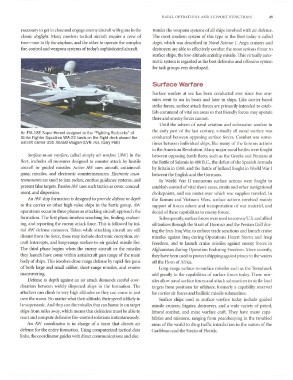
          An  F/A-18E Super Hornet assigned to the  " Fighting Redcocks"  of
          Strike Fighter Squadron VFA-22 lands on  the flight deck aboard the   conducted between  opposing surface  forces. Combat was  some-
          aircraft carrier USS  Ronald Reagan (CVN  76). (Gary  Prill)   times  between  individual ships, lil<e  many of the  famous  actions
                                                                 in the American Revolution. Many major naval battles were fought
             SLllface-to-air  warfare,  called simply air  wa/fare  CAW)  in  the   between opposing battle fleets, such as  the Greeks and Persians at
          fleet,  includes all  measures designed  to  counter attack by hostile   the Battle of Salamis in 480 B.C., the defeat of the Spanish Armada
          aircraft  or  guided  missiles.  Active  AW  uses  aircraft,  antiaircraft   by Britain in 1588, and the Battle of Jutland fought in World War I
          guns,  missiles,  and  electronic  countermeasures.  Electronic coun-  between the English and the Germans.
          termeasures are used to jam radars, confuse guidance systems, and   In  World  War  II  numerous  surface  actions  were  fought  to
          present false targets. Passive AW uses such tactics as cover, conceal-  establish control of vital shore areas, straits and other navigational
          ment, and dispersion.                                  chokepoints, and sea  routes over which  war supplies  traveled.  In
             An AW ship formation is designed to provide defense in depth   the  Korean  and  Vietnam  Wars,  surface  actions  involved  mainly
          to  the  carrier  or other high-value  ships  in  the  battle group. AW   support of forces  ashore and transportation of war materiel, and
          operations occur in three phases as attacking aircraft approach the   denial of these capabilities to enemy forces.
          formation. The first phase involves searching for,  finding, evaluat-  Subsequently, surface forces were used to convoy U.S. and allied
          ing, and reporting the enemy attack force. This is followed  by ini-  oil tankers through the Strait of Hormuz and the Persian Gulf dur-
          tial  AW  defense  measures. Taken  while  attacking aircraft are  still   ing the Iran-Iraq War, to enforce trade sanctions and launch cruise
          distant from the force, these may include electronic deception, air-  missiles  against  Iraq  during  Operations  Desert  Storm  and  Iraqi
          craft intercepts, and long-range surface-to-air guided missile  fire.   Freedom,  and  to  launch  cruise  missiles  against  enemy  forces  in
          The  third  phase begins  when  the  enemy aircraft or the  missiles   Afghanistan during Operation Enduring Freedom. More recently,
          they launch have come within antiaircraft gun range of the main   they have been used to protect shipping against piracy in the waters
          body of ships. This involves close-range defense by rapid-fire guns   off the Horn of Africa.
          of both large  and small  caliber,  short-range  missiles,  and evasive   Long-range surface-to-surface missiles such as  the Tomahawk
          maneuvering.                                           add greatly to  the capabilities of surface forces  today.  These mis-
             Defense in  depth against an air attack  demands careful  coor-  siles allow naval surface forces and attack submarines to stril<e  land
          dination  between  widely  dispersed  ships  in  the  formation.  The   targets from  positions far offshore, formerly a capability reserved
          attackers can climb to very high altitudes or they can come in just   for carrier air forces and ballistic missile submarines.
          over the waves. No matter what their altitude, their speed is likely to   Surface  ships  used  in  surface  warfare  today  include  guided
          be supersonic. And they can fire missiles that can home in on target   missile cruisers,  frigates,  destroyers,  and a wide  variety of patrol,
          ships from miles away, which means that defenders must be able to   littoral  combat,  and  mine  warfare  craft.  They  have  many  capa-
          react and compute defensive fire-control solutions instantaneously.   bilities and missions,  ranging from  peacekeeping in  the  troubled
             An  AW  coordinator  is  in  charge  of a  team  that  directs  air   areas of the world to drug traffic interdiction in  the waters of the
          defense for the entire formation. Using computerized tactical data   Caribbean and the Straits of Florida.
          links, the coordinator guides with direct communications and e1ec-

