


Page 45 - NAVAL SCIENCE 3 TEXTBOOK
P. 45
lEI Naval Communications


        Communication  means  transmlttll1g  a  message  so  the  receiver
        understands it accurately. The tools of communication are written
        and spoken words. In order to communicate well,  ideas must be
        put in the form of words that accurately convey them. This is espe-
        cially important when the messages are commands or orders.
           Naval  communications  is  the  transmission  and  reception  of
        military  instructions  and  information  by  sound, electronics, or
        visual  means. The Navy operates worldwide, so it needs a global
        communications network. A commander must be able to commu-
        nicate orders to or from ships, shore stations, and aircraft.
           Communications makes it possible for a commander to evalu-
        ate a situation and determine appropriate courses of action for his
        units from  a central command post. Without the ability to com-
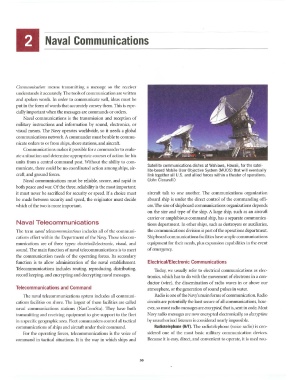
                                                               Satellite communications dishes at Wahiawa,  Hawaii,  for the satel-
        municate, there could be no coordinated action among ships, air-
                                                               lite-based  Mobile  User Objective System (MUOS) that will  eventually
        craft, and ground forces.                              link together all  U.S.  and allied forces within  a theater of operations.
           Naval communications must be reliable, secure, and rapid in   (John  Ciccarelli)
        both peace and war. Of the three, reliability is the most important;
        it must never be sacrificed for security or speed. If a choice must   aircraft  talk  to  one  another.  The  communications  organization
        be  made between security and speed, the originator must decide   aboard ship is  under the direct control of the commanding offi-
        which of the two is more in1portant.                   cer. The size of shipboard communications organizations depends
                                                               on the size and type of the ship. A large ship, such as an aircraft
                                                               carrier or amphibious command ship, has a separate communica-
        Naval Telecommunications                               tions department. In other ships, such as destroyers or auxiliaries,
        The term naval telecommunications includes all  of the communi-  the communications division is part of the operations department.
        cations effort within the Department of the Navy. These telecom-  Shipboard communications facilities have ample communications
        munications  are  of three  types: electrical/electronic,  visual, and   equipment for their needs, plus expansion capabilities in the event
        sound. The main function of naval telecommunications is to meet   of emergency.
        the communication  needs  of the operating forces. Its  secondary
        function  is  to  allow  administration  of the  naval  establishment.   Electrical/Electronic Communications
        Telecommunications includes  routing,  reproducing, distributing,   Today, we  usually  refer  to  electrical communications as  elec-
        record keeping, and encrypting and decrypting naval messages.   tronics, which has to do with the movement of electrons in a con-
                                                               ductor (wire),  the dissemination of radio waves  in  or above our
        Telecommunications and  Command                        atmosphere, or the generation of sound pulses in water.

           The naval  telecommunications system  includes all communi-  Radio is one of the Navy's main forms of communication. Radio
        cations facilities  on shore. The largest of these  facilities are called   circuits are potentially the least secure of all communications, how-
        naval  communications  stations  (NavComSta).  They  have  both   ever, so most radio messages are enC1ypted, that is, sent in code. Most
        transmitting and receiving equipment to give support to the fleet   Navy radio messages are now encrypted elech'onically, so decryption
        in a specific geographic area. Fleet commanders control all tactical   by unauthorized listeners is considered nearly impossible.
        communications of ships and aircraft under their command.   Radiotelephone  (RIT). The radiotelephone (voice radio)  is con-
           For  the operating forces,  telecommunications  is  the voice of   sidered  one  of the  most  basic  military  communication  devices.
        command in  tactical  situations.  It  is  the way  in  which ships and   Because it is easy, direct, and convenient to operate, it is used rou-


                                                            50

