


Page 41 - NAVAL SCIENCE 3 TEXTBOOK
P. 41
46      N AVAL  KN OWLEDG E


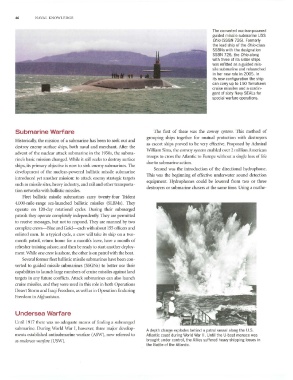
                                                                                          The converted  nuclear-powered
                                                                                          guided missile submarine USS
                                                                                          Ohio (SSGN  726).  Formerly
                                                                                          the lead  ship of the Ohio-class
                                                                                          SSBNs with the designation
                                                                                          SSBN  726, the  Ohio along
                                                                                          with three of its sister ships
                                                                                          was  refitted as  a guided  mis-
                                                                                          sile submarine and  relaunched
                                                                                          in  her new role  in  2005. In
                                                                                          its new configuration the ship
                                                                                          can  carry up to  150 Tomahawk
                                                                                          cruise  missiles and  a contin-
                                                                                          gent of sixty  Navy SEALs for
                                                                                          special warfare operations.


        Submarine Warfare                                        The  first  of these  was  the  COl1l'oy  system.  This  method  of
                                                              grouping  ships  together  for  mutual  protection  with  destroyers
        Historically, the mission of a submarine has been to seek out and
                                                              as  escort ships proved  to  be very effective. Proposed  by Admiral
        destroy enemy surface ships, both naval and  merchant. After the
                                                               William Sims, the convoy system enabled over 2 million American
        advent of the nuclear attack submarine in  the  1950s, the subma-
                                                              troops to cross the Atlantic to Europe without a single loss of life
        rine's basic mission changed. While it still seeks to destroy surface
                                                              due to submarine action.
        ships, its primary objective is now to sink enemy submarines. The
                                                                 Second  was  the  introduction of tl1e  directional  hydrophone.
        development of the  nuclear-powered  ballistic  missile  submarine
                                                              This was  the beginning of effective  underwater sound  detection
        introduced yet another mission:  to  attack enemy strategic targets
                                                              equipment.  Hydrophones  could  be  lowered  from  two  or  three
        such as missile sites, heavy industry, and rail and other transporta-
                                                              destroyers or submarine chasers at the same time. Using a mathe-
        tion networks with ballistic missiles.
           Fleet  ballistic  missile  submarines  carry  twenty-four  Trident
        4,000-mile-range  sea-launched  ballistic  missiles  (SLBMs).  They
        operate  on  l20-day  rotational  cycles.  During  their  submerged
        patrols they operate completely independently. They are permitted
        to  receive  messages, but not to  respond. They are  manned by two
        complete crews-Blue and Gold-each with about 155 officers and
        enlisted men.  In  a typical cycle, a crew will take  its ship on a two-
        month  patrol,  return  home for  a month's leave,  have  a month of
        refresher training ashore, and tl1en be ready to start another deploy-
        ment. While one crew is ashore, the otl1er is on patrol with the boat.
           Several former fleet ballistic missile submarines have been con-
        verted  to guided  missile  submarines  (SSGNs)  to  better use  their
        capabilities to launch large numbers of cruise missiles against land
        targets in any future conflicts. Attack submarines can also launch
        cruise missiles, and they were used in this role in both Operations
        Desert Storm and Iraqi Freedom, as well as in Operation Enduring
        Freedom in Afghanistan.


        Undersea Warfare

        Until 1917 there was  no adequate means of finding a submerged
        submarine.  During World  War  I, however, three  major develop-
                                                              A depth charge explodes behind a patrol vessel  along the  U.S.
        ments established antisubmarine warfare (ASW), now referred to   Atlantic coast during World  War  II.  Until the  U-boat menace was
        as IIndersea  walfnre (USW).                          brought under control, the Allies suffered heavy shipping losses in
                                                              the Battle of the Atlantic.

