


Page 42 - NAVAL SCIENCE 3 TEXTBOOK
P. 42
N AVAL OPERATIONS  AN D  SUPPORT  FU N CTIO NS   47


          matical process called triangulation, the submarine's location could
          then be pinpointed by the sounds of its engines and propellers.
             Finally,  the  depth  chalge  gave  the  destroyer  a  weapon  that
         could destroy a submarine underwater. Essentially a large canister
         of high explosives, the depth charge could be rigged to detonate at
         a preset depth.
            American scientists improved on the hydrophone system dur-
         ing World War II, calling it the sound navigation and ranging sys-
         tem  (sonar),  or underwater sound  ranging system.  By  bouncing
         sound pulses off the hull of a submarine and measuring the time
         lapse  until  the  return  of their  reflections,  the  range  and  bearing
         of the  submarine could  be  determined  almost  exactly.  The  sci-
         ence of underwater sound has continued to advance. Using sonar
         ranges and bearings to contacts, computers can quickly figure their
         courses and speeds, and  if necessary program weapons  to  attack
         them,  taking  into  account  such  variables  as  water  temperature,
         salinity, and pressure.
            Since World  War  II  significant advances  in  USW have  been
         made.  The helicopter  has  become  a  major  USW  platform.  The
         highly maneuverable nuclear-powered attack submarine (SSN) has
         become the most effective USW vessel. The SSN can use sophisti-
         cated sensing devices  to find  and attack enemy submarines with
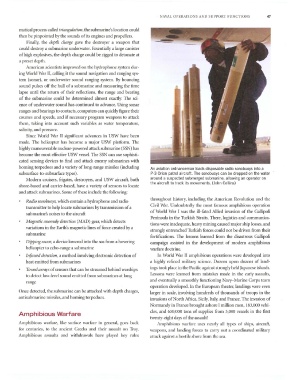
         homing torpedoes and a variety of long-range missiles (including   An  aviation ordnanceman  loads disposable radio sonobuoys into a
         subsurface-to-subsurface types).                       P-3 Orion  patrol aircraft. The sonobuoys can  be  dropped on the water
            Modern cruisers, frigates,  destroyers, and USW aircraft, both   around a suspected submerged submarine, allowing an  operator on
                                                                the aircraft to track its movements. (John  Coli ins)
         shore-based and carrier-based, have a variety of sensors to locate
         and attack submarines. Some of these include the following:
                                                                throughout history,  including the American  Revolution  and  the
            Radio sonobuoys, which contain a hydrophone and radio
                                                                Civil War.  Undoubtedly the  most famous amphibious operation
            transmitter to help locate submarines by transmission of a
                                                                of World  War  I was  the  ill-fated  Allied  invasion  of the  Gallipoli
            submarine's noises to the aircraft
                                                                Peninsula in the Turkish Straits. There, logistics and communica-
            Magnetic anomaly detection (MAD) gear, which detects
                                                                tions were inadequate, heavy mining caused major ship losses, and
            variations in the Earth's magnetic lines of force created by a
                                                                strongly entrenched Turkish forces could not be driven from their
            submarine
                                                                fortifications.  The  lessons  learned  from  the  disastrous  Gallipoli
            Dipping sonal; a device lowered into the sea from a hovering   campaign  assisted  in  the  development  of modern  amphibious
            helicopter to echo-range a submarine                warfare doctrine.
            Infrared detection,  a method involving electronic detection of   In World War II  amphibious operations were developed  into
            heat emitted from submarines                        a highly  refined  military science.  Dozens  upon  dozens  of land-
                                                                ings took place in the Pacific against strongly held Japanese islands.
            Towed arrays of sensors that can be streamed behind warships
                                                                Lessons  were  learned  from  mistakes  made  in  the  early  assaults,
            to detect low-level sound emitted from submarines at long
                                                                and eventually a smoothly functioning Navy-Marine Corps team
            range
                                                                operation developed. In the European theater, landings were even
         Once detected, the submarine can be attacked with depth charges,   larger  in  scale, involving hundreds of thousands of troops in  the
         antisubmarine missiles, and homing torpedoes.          invasions of North Africa, Sicily, Italy, and France. The invasion of
                                                                Normandy in France brought ashore I million men, 183,000 vehi-
                                                                cles,  and 650,000  tons of supplies  from  3,000  vessels  in  the  first
         Amphibious Warfare
                                                                twenty-eight days of the assault!
         Amphibious  warfare,  like  surface  warfare  in  general,  goes  back   Amphibious  warfare  uses  nearly  all  types  of ships,  aircraft,
         for  centuries,  to  the  ancient  Greeks  and  their  assault  on  Troy.   weapons, and  landing forces  to  carry out a coordinated  military
         Amphibious  assaults  and  withdrawals  have  played  key  roles   attack against a hostile shore from the sea.

