


Page 46 - NAVAL SCIENCE 3 TEXTBOOK
P. 46
NAVA L  OPERATIO NS  AND  SU PPORT  FUNCTIO NS   51


         tin ely  for  tactical  communications among surface ships, ground   pose random noise patterns on the broadcast signal. Only properly
         forces, and aircraft. There is almost no delay in transmission, and   equipped receivers can decipher such messages.
         acknowledgments can be returned immediately. Most tactical R/T   Those  using  R/T  voice  radio  communications  must  pro-
         equipment has line-of-sight capability only; that is, the radio waves   nounce  words  properly and  have  a  thorough  knowledge  of the
         go  in straight lines and do not follow the curvature of the Earth.   phonetic alphabet. Because the phonetic alphabet is used routinely
         Over-the-horizon (OTH) R/T communication can be done using   in  the Navy and other services and will  often be used  during the
         low frequency  radio or communications satellite links. Most R/T   NJROTC course of study, all cadets should learn it.
         transmissions are sent in plain language, so there must be strict cir-  Satellite  communications.  Most  long distance  and  data  com-
         cuit discipline, that is, prescribed frequencies, language, and proce-  munication  in  the  Navy  today is  done via  satellite.  The Navy  is
         dures must be used. Broadcast R/T is  considered the least secure   very active in  space satellite communications research and devel-
         means  of  electronic  communications,  because  anyone  within   opment. Essentially,  satellite  communications are  an  application
         range can copy the message. For voice communications requiring   of long distance radio relay, wherein ships, ground stations or air-
         high security, automatic encryption devices are used that superim-  craft can communicate with each other via satellite  relay stations
                                                                high  above  the Earth. There are several  different groups or con-
                                                                stellations of military communications satellites presently in orbit
                                                                and more planned  for  the future. The services  also  make  use  of
                         Phonetic   Pronunci auan   internatIOnal
                Lener
                         Alphabet    Guide    Morse Code
                                                                commercial  communications  satellites  to  provide  extra  capabil-
              A ........ . . . .  ALFA .... .. ....  AL  FA ....... .. ..   ity when needed. These links enable instant communications with
              B  .... .... ...  BRAVO ...... ..  BRAH  VO!! .. .. ..
              C..      CHARLIE ......  CHAR  LEE ...... .       military units worldwide, and allow for live  reception of televised
              D  ...........  DELTA ... .... ..  DELL  TAH ..... ..
              E  .... ...... .  ECHO .........  ECK  OH ...... .. .   sporting events and personal e-mail and video cam services wher-
              F        FOXTROT .....  FOKS  TROT .. .. ..       ever a service member may be deployed.
              G  ...... .... .  GOLF ..........  GOLF ....... .... .
              H .... ........  HOTEL ........  HOH  TELL ...... .   Tactical data links. The Navy and other armed services transmit
              L ........ . ..  INDIA .........  IN  DEE  AH .... ..
              L  ...........  JULlETT .... ..  :!Fw  LEE  ETT .. .   tactical data among surveillance and weapons control system com-
              K .......... ..  KILO ...... ....  KEY  LOH .-:-:-:-: .. .
              L ............  LIMA   LEE  MAH ...... ..         puters on ships, ground stations and aircraft via  transmission of
              M ...........  MIKE. .........  MIKE ....... .... .
              N        NO VEMBER __ .  NO  VEM  BER .. ..       digital  data over radio networks called tactical digital information
              0 .......... ..  OSCAR ........  OSS  CAH ........ .
              P ............  PAPA ........ ..  PAH  PAH ...... ..   links (TADILs) . Data transmitted over these links either directly or
              Q ...... ......  QUE BEC .......  1  KAY  !!~~ .... ..   via communication satellites can enable geographically dispersed
              R  .......... .  ROMEO ...... .. ,!  !i9~:  ME  OH . __  .
              S  .... ...... ..  SIERRA .......  SEE AIR  RAH .. ..   forces to receive a complete tactical picture of everything happen-
              T ........ ....  TANGO ........  TANG- CO ....... .
              U..      UNIFORM .....  YOlI- NEE FORM.           ing in a designated battJespace for  hundreds of miles. Other links
              V ............  VICTOR .......  yIKTAH .. .... ..
              W ...........  WHISKEy .....  WISS  KEy ..... ..   transmit tactical data  between aircraft, or between air controllers
              X  ........... 1 XRAy ........ .  ECKS  RAL ..... .
              Y  ...........  yANKEE ......  XA.NG  KEy .... ..   on land or aboard ship and the tactical aircraft they are directing.
              Z  ...........  ZULU .......... ,  ~9.Q  LOO ........ .
                                Pronunci acian   Incernauonal
                   Number
                                  Guide      Morse Code
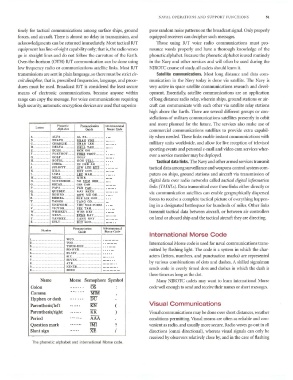
                                                                International Morse Code
              L  .. . ...... .. ...... .. ..  WUN ... .......... .... .
              2 ....... .. . . ........ ...  TOO .......... ....... ..   International Morse code is used for naval communications trans-
              3 .... ................. .  THUH·REE ..... ..... ..
              4 ....... .. ....... .... ..  FO·WER .... . ....... . . .   mitted by flashing  light. The code is  a system  in which the char-
              5 ....... ...............  FI· Y1V  .... . .. ........ ..
              6 ...... .... .. ...... .. ..  SIX .... ............. ..   acters (letters, numbers, and punctuation marks)  are represented
              7 ............... ... . .. ..  SEVEN ....... ....... ..   by various combinations of dots and dashes. A skilled signalman
              L: :::::::::::::::j ~r~t~::::: :::::::::::        sends code in  evenly timed dots and dashes in which the dash  is
                                                                three times as long as the dot.
                  Name        Morse  Semaphore  Symbol             Many NJROTC cadets  may want to  learn  international Morse
              Colon                    OS                       code well enough to send and receive their names or short messages.
              Comma                    tmJ
              Hyphen or dash           DU
              Parenthesis/left         KN        (              Visual Communications
              Paren thesis/right       KK        )              Visual communications may be done over short distances, weather
                                       AAA
              Period                                            conditions permitting. Visual  means are often as reliable and con-
              Question mark            IMI       ?             venient as radio, and usually more secure. Radio waves go out in all
              Slant sign               XE        /              directions  (omni-directional), whereas visual  signals can  only be
                                                                received by observers relatively close by, and in the case of flashing
               The  phonetic alphabet and  international  Morse code.

